
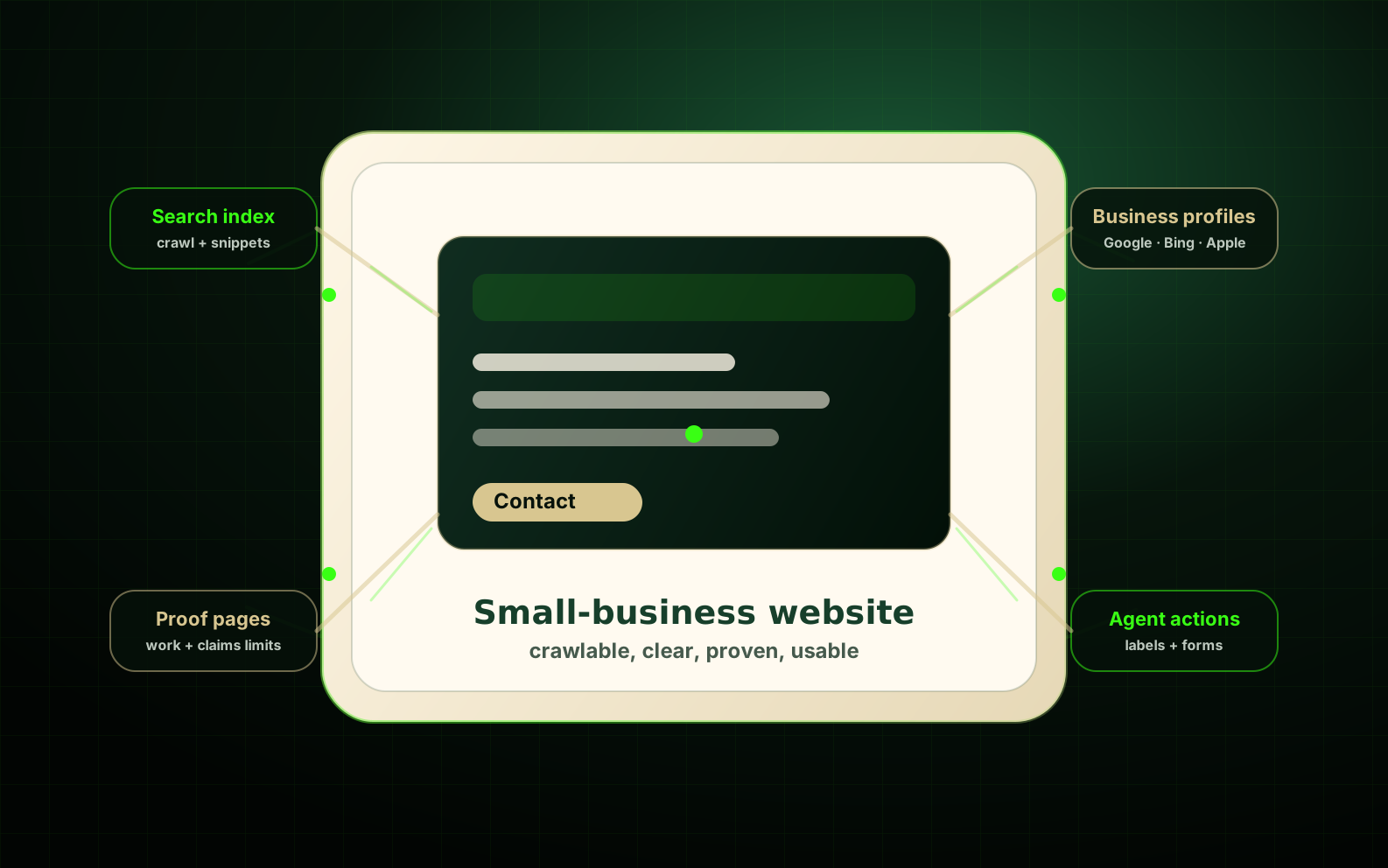
A lot of small businesses are being sold a new fear: if they do not optimize for AI search, Google AI Mode, ChatGPT, Perplexity, and Copilot will ignore them. The useful work is less mystical. Before paying for an AI SEO package, make sure your business can be found, understood, verified, compared, and contacted from public evidence.
Current as of: May 27, 2026. Platform docs, crawler names, schema behavior, and AI-search reporting are volatile. Recheck before publishing, selling, or relying on exact implementation details.
Quick answer AI search readiness is web legibility. A small-business site is more ready when important pages are crawlable and indexable, business details are clear and consistent, proof is public, actions are accessible, and performance is healthy. Google says its AI search features do not need special AI files or special AI-only markup. Other platforms expose different crawler and user-agent controls, but none publish a reliable formula that guarantees citations, rankings, leads, or mentions.
What AI search readiness actually means
A defensible definition is simple:
AI search readiness is the degree to which a business can be discovered, parsed, verified, compared, cited, and acted on by humans, search engines, answer engines, and browser agents using public evidence and accessible web experiences.
That sounds broader than SEO because it is. But SEO is still the base layer. Google’s current guidance says its AI features in Search are rooted in normal Search systems, and its generative AI optimization guidance says site owners do not need special AI files, special AI markup, or AI-only rewrites for Google AI search features.
The better mental model is not “how do I trick the LLM?” It is this:
- Discovery: can crawlers reach the important pages?
- Understanding: can the page clearly explain who the business is, what it offers, where it works, and how to contact it?
- Trust: do profiles, reviews, proof pages, and external references corroborate the same facts?
- Action: can a human or browser agent complete the next step without fighting the interface?
- Performance: does the page load, render, and stay stable enough for users, crawlers, and agents?
A business can be excellent offline and still look vague online. That is the gap this article is about.
The five-layer readiness model
Use this as an audit, not as another buzzword stack.
Readiness layers for a small-business website
| Layer | What to check | Why it matters |
|---|---|---|
| Discovery | Crawlable pages, indexable text, sitemap, internal links, normal snippet controls | Search and AI search surfaces need retrievable pages before they can show or cite them. |
| Identity | Business name, address or service area, services, About page, Contact page, profiles | Reduces ambiguity when systems compare similar businesses or local options. |
| Evidence | Reviews, real photos, case studies, testimonials, pricing or process pages, dated proof | Gives humans and retrieval systems something concrete to evaluate instead of vague claims. |
| Action | Labeled forms, real buttons, clear booking/contact paths, visible success and error states | Browser agents and humans both fail when the site uses confusing controls or hidden steps. |
| Performance | Healthy Core Web Vitals where possible, stable layouts, accessible resources, careful JavaScript | Reduces friction for users, crawlers, renderers, and agents without pretending speed is magic. |
Discovery: get the boring crawl/index layer right
For Google AI features, the floor is still normal Search eligibility. The page needs to be reachable, indexable, and eligible for snippets or links where Google uses those systems. If a service page is blocked by noindex, buried behind a broken route, or dependent on fragile client-side rendering, it is not “AI ready.” It is just hard to retrieve.
Start with the dull checks:
- key pages return HTTP 200;
- important text is visible in the page, not only in images or delayed widgets;
- service and location pages are internally linked;
- titles and meta descriptions are specific;
- canonical URLs are sane;
- sitemap and robots rules are not fighting the site.
That work is not glamorous. It is also the part many sites skip before buying the shiny nonsense.
Identity: make the business unambiguous
AI-mediated search has an entity problem before it has a persuasion problem. If the web cannot clearly identify the business, its services, its location, and its official contact routes, answer systems have to guess or avoid the result.
A credible small-business footprint usually needs:
- one official domain;
- a homepage that plainly says what the business does;
- an About page with real business context;
- a Contact page with usable contact routes;
- one page per real core service;
- location or service-area clarity;
- maintained Google Business Profile, Bing Places, and Apple Business presence where relevant;
- real reviews and a reply process;
- dated proof assets such as photos, case studies, testimonials, or project examples.
Structured data can help here, but it is not a magic switch. Use Organization, LocalBusiness, Service, Article, Breadcrumb, or FAQ markup only when it accurately matches visible page content and the site implementation supports it.
Evidence: publish proof because buyers need it first
The strongest AI-readiness content is usually useful to a human even if no AI system ever cites it.
Good proof pages answer questions like:
- What did you do?
- For whom?
- In what location or service context?
- What changed?
- When was this true?
- What was the method?
- What are the limits of the claim?
For a web-design business, that might mean project pages, before/after screenshots, performance audit notes, accessibility fixes, pricing scope, or a process page. For a mechanic, it might mean inspection checklists, service thresholds, photos, and maintenance guidance. For a landscaper, it might mean seasonal timing, before/after conditions, and field notes.
The bad version is fake proof: fake reviews, fake awards, fake benchmark pages, or universal “better than competitors” claims with no method. That does not build trust. It creates claims risk.
Action: make the site usable by humans and agents
Browser-agent readiness overlaps hard with accessibility and ordinary frontend discipline. Agent guidance from web.dev and OpenAI’s publisher material points toward semantic controls, accessible names, stable layouts, labels, roles, states, and visible feedback.
Practical fixes:
- use real
<button>elements for actions and real<a>elements for links; - connect labels to inputs with
forandid; - avoid placeholder-only form labels;
- keep “Book,” “Call,” “Request quote,” and “Contact” actions stable and visible;
- show loading, error, and success states;
- avoid popups or overlays that cover task-critical controls;
- keep forms short enough to complete without detective work.
This is not just for AI. It is the same stuff that stops human visitors from rage-clicking your site into the void.
What not to buy
A lot of “AI SEO” offers are just old SEO theater with new packaging. Some are experiments worth watching. Some are expensive confetti.
AI search claim check
| Claim | Safer interpretation |
|---|---|
| “We guarantee AI citations.” | Unsupported. You can improve source-worthiness, not guarantee selection. |
“You need llms.txt for Google AI Overviews.” | False for Google’s current Search guidance. Google says no special AI file is required. |
| “Schema makes LLMs understand your business.” | Too strong. Schema gives explicit machine-readable clues when it matches visible content. |
| “Lighthouse 100 gets you recommended by AI.” | Unsupported. Lighthouse is a diagnostic score, not a documented AI citation factor. |
| “Publish hundreds of AI answer pages.” | Usually thin-page spam. Build fewer pages that answer real buyer questions well. |
| “Block training bots and you disappear from ChatGPT Search.” | Wrong framing. OpenAI documents separate search and training crawlers. |
The safe public promise is narrower: we can make the site easier to discover, parse, verify, compare, and use. That is useful. It does not pretend to control every answer engine.
Platform controls worth checking
Different systems expose different controls. Do not collapse them into one fake “AI bot” category.
Crawler and search-surface controls
| Platform | What to check | Caveat |
|---|---|---|
| Google Search AI features | Googlebot access, indexability, snippet eligibility, structured data sanity, Google Business Profile where relevant | Google says no special AI files or special AI schema are required for Search AI features. |
| OpenAI / ChatGPT Search | OAI-SearchBot for search appearance, GPTBot for potential training use, ChatGPT-User for user-triggered actions | Search crawling and training crawling are documented separately; inclusion is still not guaranteed. |
| Perplexity | PerplexityBot for search, Perplexity-User for user-triggered fetches, WAF/IP controls if strict blocking matters | Perplexity’s own docs say user-triggered fetch behavior is different from normal robots assumptions. |
| Bing / Copilot | Bing Webmaster Tools, sitemap, URL inspection, IndexNow, Bing Places for local businesses | Copilot surfaces can use Bing-backed web grounding, but cross-surface source selection is not fully transparent. |
| Apple ecosystem | Apple Business presence and accurate business details where relevant | Useful for local entity consistency, not a replacement for a real website. |
For most local businesses, this boils down to a clear policy:
- allow normal search crawlers if visibility matters;
- block training crawlers only if that matches the business’s content policy;
- use
noindex, snippet controls, and WAF rules intentionally; - measure what actually appears instead of trusting vendor folklore.
Performance is a friction layer, not a citation switch
Performance matters. The overclaim is where people get sloppy.
Google documents Core Web Vitals as part of its page experience and ranking systems, but also says strong page-experience results do not guarantee top rankings. Lighthouse is useful for debugging, but the Lighthouse Performance score itself is not documented as a direct ranking factor or AI citation factor.
Use this split:
Performance evidence: what each metric is good for
| Signal | Best use | Do not claim |
|---|---|---|
| Core Web Vitals field data | Understand real-user loading, responsiveness, and layout stability | “Good CWV guarantees rankings or AI mentions.” |
| Lighthouse lab score | Debug before/after technical changes in controlled conditions | “Lighthouse 100 makes AI systems cite us.” |
| JavaScript/rendering audit | Find content that crawlers or agents may miss | “Any JavaScript site is bad.” |
| Accessibility/agent checks | Confirm forms, buttons, labels, and states are machine-readable | “Agents can complete every task if ARIA exists.” |
The practical rule is this: fast, stable, semantic pages reduce friction. They help humans use the site. They help crawlers render and understand it. They help browser agents identify actions. But performance alone does not make the business credible, relevant, local, or cite-worthy.
The biggest performance risks for AI readiness are not tiny 20ms wins. They are structural problems:
- critical content hidden behind fragile JavaScript;
- blocked CSS or JS needed to understand the page;
- lazy-loaded content that never becomes visible to crawlers;
- layout shifts near forms and booking buttons;
- intrusive popups that cover actions;
- unlabeled forms and fake buttons built from generic divs.
Fix those before flexing a score screenshot.
What a small business should fix first
Here is the practical build order.
30/60/90-day readiness plan
| Window | Focus | Outcome |
|---|---|---|
| 30 days | Crawl/index basics, core routes, metadata, Search Console, Bing Webmaster, Google/Bing/Apple profiles, contact details | The business becomes technically legible and profile-consistent. |
| 60 days | Service pages, About page, Contact page, proof page, basic schema, labeled forms, real reviews and photos | The site becomes easier to understand, verify, and contact. |
| 90 days | Case studies, pricing/process/comparison pages where useful, Core Web Vitals improvements, repeated answer-engine tests | The business becomes easier to compare, cite, and improve over time. |
Minimum route map
Most small-business sites do not need a thousand pages. They need the right pages to exist and say something useful.
A credible starting map:
//about/contact/services/services/[service]/areas/[city-or-service-area]only when genuinely useful/case-studies/[project]or/work/[project]/reviewsor testimonials where appropriate/pricingor/packageswhen scope can be explained honestly/faqonly when based on real questions/robots.txt/sitemap.xml
For a local web-design business, that also means keeping Web Design in Kawartha Lakes, See Work, See Pricing, and More Research Notes linked where they help a reader make the next decision.
Measurement without delusion
Do not use one AI answer as proof that the strategy worked. These systems move.
A better monthly test set includes:
- branded query: “Who is [business]?”
- service query: “Who offers [service] in [city]?”
- proof query: “Examples of [business] work”
- comparison query: “[business] vs [competitor] for [criterion]”
- action query: “How do I contact or book [business]?”
Log which sources appear, whether facts are stale, whether the official site is cited, and whether profiles or third-party pages dominate. Then fix the weakest layer: site clarity, profiles, proof, performance, or contact flow.
Useful next step
Send your current site, social profile, booking link, or business details. I’ll show what is working, what is missing, and what is worth fixing first.
FAQ
Is AI search readiness the same as SEO?
No. SEO is still the foundation, especially for Google AI features, but AI search readiness also includes entity clarity, public proof, crawler controls, accessible action flows, and measurement across answer engines and browser agents.
Do I need llms.txt to appear in Google AI Overviews or AI Mode?
Google’s current guidance says no. Google says site owners do not need special AI files such as llms.txt, special AI markup, content chunking, or AI-only rewrites for its generative Search features. That claim is Google-specific and should be rechecked as guidance changes.
Does schema make AI systems understand my business?
Schema can help by giving explicit machine-readable clues, but it is not magic. Use structured data only when it accurately describes visible page content, and do not treat it as a guarantee of AI visibility.
Does a Lighthouse 100 score help AI search?
A Lighthouse score is useful for debugging site performance, but it is not documented as a direct AI citation or ranking factor. Core Web Vitals field data is more relevant to Google’s page-experience systems, and even good field data does not guarantee rankings or AI mentions.
What should a small business fix first?
Fix the basics first: crawlable pages, clear service pages, consistent business details, maintained profiles, real proof, accessible contact paths, and no catastrophic performance or rendering issues. Advanced experiments come after those foundations are real.
Source notes
- Google Search Central: AI features and your website - supports the claims that Google AI features use Search systems, normal preview controls, and no extra AI-specific technical requirements for Search AI visibility.
- Google Search Central: Optimizing your website for generative AI features - supports the claims that SEO remains relevant for Google generative AI features and that Google does not require special AI files, special AI markup, chunking, or AI-only rewrites.
- Google Search technical requirements and Google SEO Starter Guide - support crawlability, indexability, internal links, titles, snippets, and normal SEO fundamentals.
- Google structured data introduction - supports the guidance to use structured data as explicit clues only when it matches visible content.
- Google business details guide and Google Business Profile ranking tips - support the local business identity, profile completeness, reviews, photos, and corroboration guidance.
- OpenAI crawler overview and OpenAI publisher/developer FAQ - support the distinction between OAI-SearchBot, GPTBot, and user-triggered browsing behavior, plus the caution that inclusion is not guaranteed.
- ChatGPT Search help - supports the description of ChatGPT Search using web search and sources at a high level.
- Perplexity crawler documentation - supports the distinction between PerplexityBot and Perplexity-User plus WAF/IP control notes.
- Microsoft Copilot public web access, Bing Webmaster Tools, and Bing Places - support Bing/Copilot grounding, indexing workflow, IndexNow, and local profile maintenance.
- Apple Business Connect - supports the recommendation to maintain an Apple business presence where local discovery matters.
- web.dev: Build agent-friendly websites and W3C WAI form labels - support the semantic HTML, labels, accessible forms, stable layout, and agent-friendly UX guidance.
- Google Core Web Vitals, Google page experience guidance, Lighthouse performance scoring, and web.dev lab and field data - support the performance section, including the distinction between field data and lab diagnostics and the warning against ranking or citation guarantees.