
Measures the URL.
- flags technical symptoms without business context
- treats every warning like the same priority
- cannot see whether the offer, proof, or CTA makes sense
- often ends as a PDF dump with no decision attached
Website Upgrade Opportunity Plan
A useful website audit is not a robot score or a pitch disguised as diagnosis. Peter reads the public buyer path, service clarity, proof, mobile behavior, search surface, and contact flow so the next move can be smaller, clearer, and worth doing.
A First Read is a quick first pass, not a free full professional audit.
Human review, business context
A useful audit connects public evidence to the customer decision and then tells you what deserves attention first.
Diagnostic field
Can a new visitor tell what the business does, where it works, and what to do next without translating vague copy?
Do services, proof, objections, pricing cues, and the next action appear in the order a real decision needs them?
Are real work, credentials, reviews, policies, ownership, and local facts placed near the decisions they support?
Can people read, compare, tap, call, book, or send a request without fighting the layout on a phone?
Do titles, descriptions, canonicals, crawlable copy, sitemap routes, and service intent agree with the visible page?
Do forms, calls, booking links, ownership, redirects, tracking, and launch checks support the path instead of quietly breaking it?
The checklist changes with the buyer
The audit uses the business model and customer decision to decide what matters. These are decision-path examples, not claims that every business needs the same page stack.
Service scope, areas served, relevant work, estimate inputs, and a clean quote path.
Service choice, provider fit, price or consultation rules, policies, and booking handoff.
Hours, location or service area, call and direction paths, trust, and offer clarity.
Credentials, claim safety, privacy cues, process, fit, and consultation path.
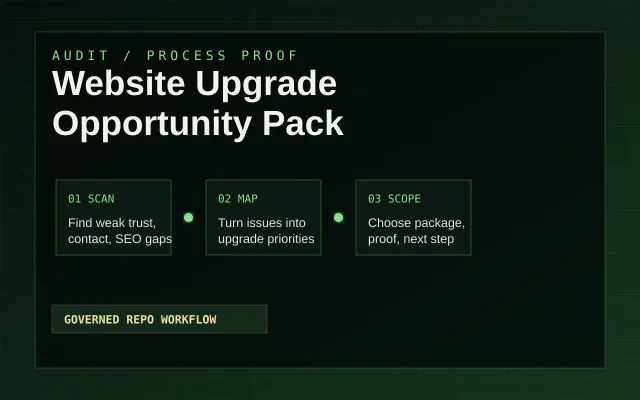
Labeled audit sample
Peter can start with a Free First Read and only move into a deeper Website Upgrade Opportunity Plan when the business actually needs that level of diagnosis.
This is an example of the finding structure, not a claim about a specific client or website.
The output is a decision
The useful outcome is the smallest route that actually addresses the leak without throwing away healthy work.
Use when the structure is mostly healthy and the problem is a specific path, page, form, image, metadata, or mobile issue.
Use when the public facts and page map still work, but the hierarchy, wording, proof, or visual presentation is weak.
Use when the current structure makes services hard to understand, hides proof, or forces the customer to hunt for a next step.
Use when one service, campaign, or high-intent offer needs a tighter destination than the broad homepage.
Use when the current site is too thin, brittle, inaccessible, or operationally risky to repair without recreating the same problems.
How it works
Share the website, Google profile, booking page, social page, or other public link. Do not send passwords or private customer data.
The review starts with what a real customer must understand, trust, compare, and do next, then checks the supporting technical surface.
Important leaks are separated from polish. Each useful finding connects the observation, buyer impact, evidence, and next move.
The answer may be a repair, refresh, redesign, focused page, deeper Upgrade Opportunity Plan, or no immediate rebuild at all.
Plain answers
No. It is a short first read that points the business toward the smallest useful path. Deeper audit and upgrade-plan work is scoped separately when it is needed.
Yes. A Google Business Profile, Facebook page, booking link, Square page, or business basics are enough to start the conversation.
No. A useful outcome may be a specific repair, clearer service page, mobile cleanup, focused landing page, deeper upgrade plan, or no immediate rebuild at all.
No. The work can identify and prioritize clarity, proof, discovery, performance, and contact-path problems. Rankings, lead volume, and business outcomes depend on factors beyond the website review.
Direction before production
Send the current public trail. Peter will tell you whether the useful next move is a small repair, a clearer page, a deeper Upgrade Opportunity Plan, or a rebuild worth scoping.