
A business starts running Google Ads and gets the same blunt recommendation from three different people:
Never send ads to your homepage. Build a dedicated landing page for every campaign.
Sometimes that advice fixes a real problem. Sometimes it creates a pile of near-duplicate pages, stale offers, mismatched phone numbers, forgotten forms and extra maintenance—with no evidence that the new page is better.
The useful question is not homepage or landing page?
It is:
Which available page most completely finishes the job started by the search and the ad?
Google uses *landing page* to mean the page someone reaches after clicking an ad. That destination can be a homepage, service page, product page, location page, guide, booking page or a page created specifically for paid traffic. A dedicated paid landing page is one possible page type, not a Google requirement.
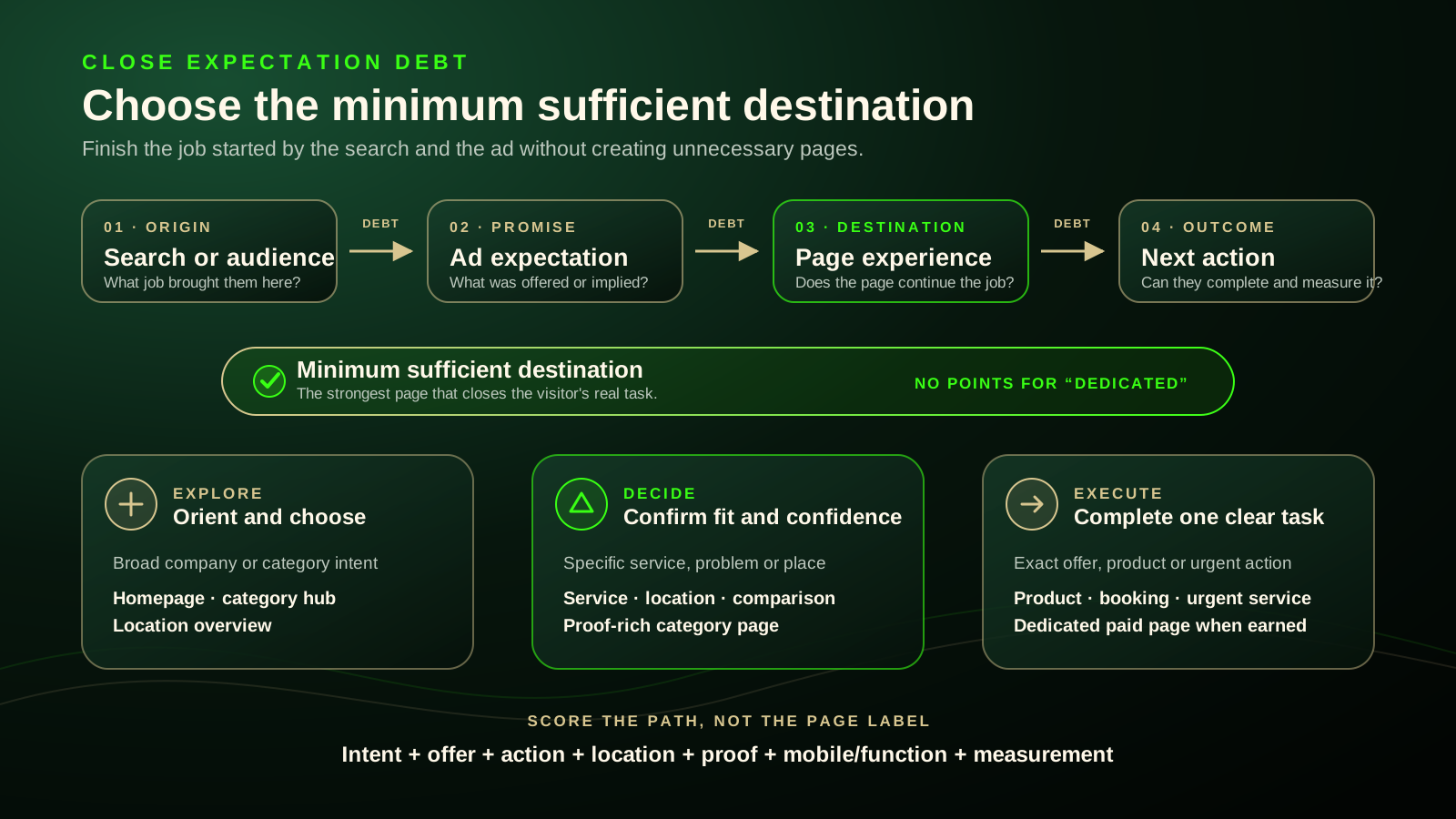
Quick answer Send the click to the minimum sufficient destination: the existing or purpose-built page that best matches the search intent, continues the ad’s promise, provides enough proof, supports the intended action, works on mobile and can be measured correctly. A homepage can win for broad brand or company-level intent. A strong service page is often the best answer for a specific service. A dedicated paid page earns its upkeep when the campaign needs a materially different offer, audience, location, conversion path, qualification flow or experiment.
Current as of: Google Ads and Google Search guidance were checked August 28, 2026. Platform terminology, campaign features, reporting and policy details can change, so recheck current documentation before changing a live account.
First, fix the terminology
In Google Ads, the landing page is simply the destination reached after the click, usually through the ad’s final URL.
That is different from the marketing-industry use of dedicated landing page, which normally means a page built or materially adapted for one campaign, audience, offer or action.
The distinction matters because a lot of advice quietly swaps one definition for the other:
- Google says the landing page should be relevant and useful.
- A marketer assumes “landing page” means a separate paid-only page.
- The recommendation becomes “Google wants you to build a separate page.”
That final step does not follow.
Google’s current guidance focuses on whether the destination matches the ad and keywords, continues the advertised offer or call to action, is useful, works on mobile, is easy to navigate and allows the visitor to complete the intended action. It does not award a special quality bonus because a URL was created only for paid traffic.
So throughout this guide:
- landing page means any page receiving the ad click;
- dedicated paid landing page means a separate campaign-focused destination;
- destination means the page or surface being evaluated, regardless of its label.
The decision rule: use the minimum sufficient destination
Every ad click creates an expectation chain:
search or audience → ad promise → destination page → next action
At each handoff, the visitor may have to reinterpret, re-find or reconfirm something.
That extra work is expectation debt.
A person searches for “custom fire pit installation Fenelon Falls,” clicks an ad about custom fire pits, then lands on a general landscaping homepage. The business may genuinely offer the service, but the visitor still has to:
- find fire pits in the service list;
- verify that Fenelon Falls is covered;
- locate relevant project proof;
- determine whether installations are available;
- find the correct quote action.
The homepage has not necessarily failed. It has simply left a large amount of the click’s original task unfinished.
A minimum sufficient destination closes that debt without creating unnecessary pages.
It should answer, at the level appropriate to the search:
- Am I in the right place?
- Is the promised service, product or offer actually here?
- Does it apply to my location or situation?
- Is there enough proof and context to continue?
- Can I take the action the ad promised?
- Will that action work and be measured properly?
A separate paid page earns its existence only when it materially improves those answers beyond what an existing page can reasonably do.
Route the click by the job: explore, decide or execute
The destination becomes easier to choose when you identify the job the visitor is trying to complete.
| Visitor job | Typical search or campaign intent | Usually strongest starting destination | What the page must do |
|---|---|---|---|
| Explore | business name, brand research, broad category, several possible services | homepage, category hub or location overview | explain the business, show credible options and help the visitor choose a path |
| Decide | specific service, problem, location or comparison | service page, location page, comparison guide or focused category page | confirm fit, answer decision questions, show proof and support a relevant next step |
| Execute | exact product, promotion, booking, urgent call, defined quote request | product page, booking page, urgent service page or dedicated paid page | complete one clear task with minimal unnecessary friction |
This is a routing model, not a rigid law.
A branded search can still deserve a deeper page when the ad promises a specific promotion. A broad category search can deserve a focused category page rather than the homepage. A high-value consultation may need more company context than a simple “execute” label suggests.
But the model exposes the mistake behind many weak destinations: the campaign asks someone to execute, then sends them to a page designed only to explore.
When the homepage is the right destination
A homepage is legitimate when the search and ad are genuinely about the business as a whole.
Strong homepage cases can include:
- a branded search for the company name;
- a business with one primary service and one primary audience;
- a broad ad that accurately introduces several relevant services;
- a visitor who reasonably needs company-level orientation before choosing;
- a local office or business search where identity, location and navigation are part of the task.
The homepage still has to earn the click.
A useful homepage destination should make it easy to identify:
- what the business does;
- who it serves;
- where it works;
- why it is credible;
- where the relevant service information lives;
- how to contact or continue.
A homepage becomes a weak destination when a specific promise disappears into general company copy.
Common symptoms include:
- the ad names one service, but the page opens with a vague brand slogan;
- the location promised in the ad is hard to confirm;
- the relevant proof is buried in a general gallery;
- five unrelated actions compete with the intended action;
- the visitor must reopen navigation and repeat the search they already completed;
- mobile users have to scroll through broad company material before finding the promised service.
The problem is not that the URL ends in /. The problem is that the page does not finish the click’s task.
Why a strong service page is often the best answer
The most useful option is frequently ignored in the homepage-versus-landing-page debate: the existing service page.
A good service page can provide focus without stripping away context. It can serve paid, organic, referral and direct visitors while keeping one maintained source of truth for:
- service scope;
- service-area details;
- process;
- project proof;
- qualifications;
- price orientation;
- common objections;
- phone, form or booking actions.
That is especially valuable for local and higher-consideration services. Someone considering a major roofing project, legal engagement, landscaping build or commercial service may reasonably want to inspect the company, previous work, process and related information before contacting anyone.
An existing service page is a strong Google Ads destination when it:
- names the searched service clearly;
- continues the ad’s actual promise;
- confirms the relevant location or service area;
- gives enough information to judge fit;
- includes proof relevant to that service;
- supports the campaign’s intended action;
- works cleanly on mobile;
- has reliable call, form or booking delivery;
- can be maintained without paid and organic versions drifting apart.
Do not clone a strong service page solely to obtain a special-looking paid URL.
A duplicate introduces new failure modes:
- one page receives updated pricing while the other does not;
- reviews, hours or service areas diverge;
- one form routes correctly and the other breaks;
- photos and proof go stale;
- search engines must interpret two substantially similar URLs;
- staff no longer know which page is authoritative.
A dedicated page may still be justified. But it should solve a named mismatch, not satisfy a ritual.
When a dedicated paid page earns its upkeep
A separate paid page makes sense when the campaign needs something materially different from the main site page.
| Material difference | Why an existing page may be insufficient | What the dedicated page should add |
|---|---|---|
| Campaign-specific offer | the normal page does not contain the promised discount, package, incentive or deadline | exact offer terms, eligibility, matching proof and the promised action |
| Narrow audience | the service page speaks to several buyer types with different objections | audience-specific framing, proof, qualification and next step |
| Different conversion action | the normal site asks for general contact while the campaign needs a booking, estimate, consultation or specialized intake | one proportionate flow tied to the campaign goal |
| Urgent or call-first intent | the normal page makes availability, coverage or calling too hard to verify | immediate service-area confirmation, hours or availability, call action and backup path |
| Real geographic variation | availability, proof, branch details, pricing or constraints differ by place | truthful local information—not city-name swapping |
| Paid-only qualification logic | the campaign needs minimum job size, eligibility, budget or project-type filtering | clear fit boundaries before the form or call |
| Controlled experiment | the business has a meaningful hypothesis that cannot be isolated safely on the core page | a measurable variant with one defined change and success criterion |
| Promotion or lead magnet | the general site does not explain the exchange or consent clearly | offer-specific explanation and delivery path |
The dedicated page must add customer value or measurement value.
Changing the headline, hiding navigation and copying the same body text into a new URL is not a serious strategy. It is a duplicate with a haircut.
Before building, finish this sentence:
We need a separate page because the current page cannot support ______ without becoming worse or confusing for its other visitors.
Useful answers include:
- a distinct promotion;
- a different audience;
- a call-first emergency path;
- a campaign-specific booking flow;
- a genuinely different geographic offer;
- an experiment with a clear hypothesis.
“Because PPC pages convert better” is not enough. Better under what conditions, for which visitors, compared with which existing page, measured by which outcome?
Other destinations can beat both options
Homepage versus dedicated page is often the wrong binary because other page types may fit the click more precisely.
Product or variant page
A click for an exact product, model, size or variant generally belongs on the matching product destination, with the advertised price and availability represented accurately.
Sending an exact-item click to the homepage or a generic store page forces the visitor to repeat the product search.
Location or service-area page
When geography is part of the query or ad promise, the destination should make location applicability easy to prove.
That does not justify manufacturing a page for every town. A location page earns its place when it contains real local usefulness: branch details, coverage, hours, constraints, availability, projects, directions or other evidence that changes the decision.
Category or collection page
A broad product or service-category search may require exploration.
A category page can be more useful than a hyper-specific paid page when the visitor still needs to compare options. Prematurely narrowing a broad search can be just as unhelpful as sending a specific search to a broad homepage.
Booking or functional page
A booking page can be the right destination when the visitor already understands the service and the ad clearly promises scheduling.
It becomes the wrong destination when it asks for a commitment before supplying the context, price boundaries, terms or proof a reasonable buyer needs.
Guide, calculator or comparison
A research destination can be correct when the campaign deliberately targets research-stage demand.
Forcing “cost,” “compare,” “how does it work?” or “which option?” searches directly into a quote form may violate the task implied by the ad. A useful guide can answer the question first, then offer the appropriate next step.
Score the candidate page, not its label
Use this scorecard before building anything.
Score each candidate destination from 0 to 2 on seven factors:
| Factor | 0 — fails | 1 — partial | 2 — strong |
|---|---|---|---|
| Intent match | page serves a different task | relevant service exists but requires hunting | page directly addresses the visitor’s actual task |
| Offer match | advertised offer is absent or contradicted | offer is mentioned weakly or incompletely | promise, terms and page content agree |
| Action fit | page asks for the wrong action or action is broken | action exists but is unclear or awkward | intended call, form, booking or purchase is obvious and functional |
| Location fit | applicability is missing or wrong | area is implied or buried | relevant location or service boundary is clear |
| Proof sufficiency | little reason to trust the claim | generic proof with limited relevance | proof answers the uncertainty attached to this decision |
| Mobile and functional readiness | page is difficult or broken | usable with friction | core content and action work cleanly on common devices |
| Measurement readiness | real outcome cannot be distinguished | partial events exist | meaningful calls, submissions, bookings or purchases are defined and testable |
Maximum score: 14.
This is a Synapse diagnostic heuristic, not a Google metric, Quality Score formula or conversion guarantee.
Use it as a decision aid:
- 11–14 with no critical zero: the existing page is probably a viable destination; improve specific weaknesses before creating a duplicate.
- 8–10: the page may be fixable, but the campaign-to-page mismatch deserves focused work or a controlled test.
- 0–7, or a zero in intent, offer or action fit: the destination is likely asking the click to do too much or doing the wrong job.
The most important rule is that a page receives zero extra points for being dedicated.
A purpose-built page can score badly. A homepage can score well. The scorecard evaluates the visitor’s path, not the page’s marketing label.
Navigation should follow the buying risk
There is no universal evidence-backed rule that every paid landing page should remove navigation.
Navigation changes the tradeoff between focus and exploration.
| Navigation model | Best fit | Main risk |
|---|---|---|
| Full navigation | brand traffic, complex services, high-consideration decisions, visitors who need company context | unrelated choices can dilute the primary path |
| Reduced navigation | focused service or campaign traffic that still needs proof, process, work or company identity | poor selection can preserve distraction without enough trust |
| No primary navigation | narrow promotion, simple lead magnet, low-complexity action or controlled experiment | visitors can feel trapped or unable to verify the business |
For a free downloadable checklist, removing most navigation may be harmless.
For a $25,000 home project, hiding the company, work, process and broader site may remove information the buyer reasonably needs before inviting someone onto the property or committing to a consultation.
A focused page should not feel like a locked room.
A useful reduced-navigation model can retain:
- the company logo linked to the main site;
- one or two proof or process paths;
- the primary phone, form or booking action;
- business identity and required policy links in the footer.
Treat navigation as a hypothesis tied to buying risk. Test it where the account has enough qualified traffic to learn something.
A dedicated page is not a Quality Score hack
Google’s visible 1–10 Quality Score includes landing-page experience as one diagnostic component. Google also says that the 1–10 score itself is not an input in the ad auction.
Ad Rank is calculated at auction time and can use auction-time quality measurements, including landing-page experience. Those are related ideas, but they are not the same thing.
The practical takeaway is not “landing pages do not affect ads.”
It is:
Google evaluates the experience and relevance of the destination. It does not require the destination to be a separate paid-only page.
Do not create a duplicate URL merely to chase the visible score.
Improve the page that best serves the click. Build a separate page when you can name the material mismatch it will solve. Then verify the result through real campaign outcomes rather than treating one diagnostic number as the business goal.
Mobile and measurement can invalidate an otherwise good page
A destination can look perfect in a desktop review and fail where the traffic actually arrives.
Test the page on the devices and paths used by the campaign:
- Does the service or offer appear quickly?
- Can the visitor confirm the location?
- Can the phone number be tapped?
- Does the form fit the screen and recover from errors?
- Does the booking tool work without awkward redirects?
- Are sticky bars, chat widgets or consent prompts covering the action?
- Does the page respond promptly enough to use?
- Can proof be read without fighting a gallery or carousel?
Then test delivery and measurement.
A dedicated page does not automatically fix tracking. It can make tracking cleaner by giving the campaign a unique URL, form or event, but the implementation still has to distinguish:
button click → completed action → delivered inquiry → qualified lead → sale
A phone-number tap is not automatically a completed call. A form event is not proof that the message reached the business. A thank-you screen is not proof that the inquiry was qualified.
When the destination appears correct but results are still weak, use the broader website traffic-without-leads diagnostic to trace delivery and follow-up. For campaign-specific problems such as search terms, location targeting and conversion definitions, use the Google Ads clicks-without-leads guide.
Decide indexing separately from paid use
A page does not have to be indexed because ads use it, and it does not have to be excluded from search because it was built for a campaign.
Choose deliberately.
Existing service page
Keep it indexable when it is part of the public website and deserves to appear in organic search.
Unique paid page with wider public value
It may remain indexable when the page is genuinely useful, distinct and appropriate for search visitors beyond the campaign.
Paid-specific page with no organic role
Use noindex when the page should remain accessible to ad traffic but should not appear in organic search.
The crawler must still be able to access the page to see the noindex directive. Do not casually block the destination in robots.txt and assume that produces the same result.
Genuine duplicate
Canonicalization may be appropriate when the paid and organic pages are actually duplicate or very similar versions of the same content.
Do not use a canonical tag as a magic clean-up tool for two pages that make different offers, contain materially different information or serve different intents.
The better first question is simpler:
Why do both URLs need to exist?
If there is no useful answer, maintain one strong page.
Six routing examples
1. A branded search for a landscaping company
Search: Shaw's NatureScapes
Likely destination: homepage.
The visitor may want company identity, service options, project proof and contact information. A narrow interlock landing page would prematurely assume which service they need.
2. A specific local service search
Search: custom fire pit installation Fenelon Falls
Likely destination: a focused fire-pit service page or a genuine local service page.
The click needs service confirmation, location fit, relevant project proof and a quote path. A generic landscaping homepage creates avoidable expectation debt.
3. An emergency service search
Search: emergency frozen pipe repair near me
Likely destination: an urgent, call-first service destination.
The page should prioritize coverage, availability, phone access and what happens next. The exact URL type matters less than whether the urgent task can be completed immediately—and whether anyone can actually answer.
4. A high-consideration roofing campaign
Ad promise: premium roof-system consultation.
Likely destination: a proof-rich service page or a dedicated consultation page with reduced or full trust navigation.
A stripped page containing only a headline and form may remove the process, materials, work examples, company identity and qualification context needed for a major property decision.
5. An exact product or variant
Search: a specific model, size or colour.
Likely destination: the matching product or variant page.
The visitor should not have to search the store again or discover that the advertised price and availability belong to a different version.
6. A research-stage cost campaign
Search: how much does a small business website cost in Ontario
Likely destination: a current pricing guide, calculator or pricing page—if the campaign intentionally targets research-stage demand.
A hard quote form may be too early. The destination should answer the price question, explain the variables and then offer a useful next step.
A 30-minute destination audit
Use the top meaningful traffic first. Do not begin by designing a new page.
1. Collect the real search and campaign groups
Use actual search terms, keyword themes, audiences or ad groups. Avoid judging only from the campaign name.
2. Write the promise beside each group
What did the ad lead the visitor to expect?
Be specific:
- emergency call;
- free estimate;
- one named service;
- one promotion;
- one product;
- company overview;
- comparison or education.
3. Record the actual destination
Include final URLs, mobile variations, redirects and any automated URL-selection settings that can change where traffic lands.
4. Classify the visitor job
Mark each group:
- Explore
- Decide
- Execute
5. Score the destination
Use the seven-factor scorecard:
intent + offer + action + location + proof + mobile/function + measurement
6. Mark the first critical mismatch
Do not list twenty design preferences. Identify the first reason the click cannot continue cleanly.
Examples:
- exact service lands on general homepage;
- ad promises free estimate, page asks for consultation;
- location is not confirmed;
- call action is hidden on mobile;
- form submits but notification fails;
- page contains the right service but no relevant proof.
7. Choose one intervention
| Audit result | Best next move |
|---|---|
| Existing page scores strongly | keep it, repair narrow weaknesses and measure |
| Existing page is relevant but incomplete | improve the page before duplicating it |
| Existing page cannot support the campaign without confusing other visitors | build a dedicated paid page |
| Several campaign themes land on one page but require different promises | split only the materially different themes |
| Page works but calls/forms are mismeasured | fix measurement, not the layout |
| Search terms or geography are wrong | fix campaign qualification before rebuilding the page |
8. Test the real path
Complete the call, form, booking or purchase on mobile and desktop. Confirm the business receives it. Confirm reporting records the correct event once.
Only then decide whether the page itself needs replacement.
When to build the new page
Build a dedicated paid page when all of these are true:
- A material mismatch exists.
You can name exactly what the current page fails to support.
- The new page has a distinct job.
It owns a specific offer, audience, action, geography, qualification path or experiment.
- The business can maintain it.
Pricing, proof, contact information, policy details and forms will not be abandoned after launch.
- Measurement is defined.
You know which completed action matters and how it will be verified.
- The page does not create unnecessary search or content duplication.
Indexing, canonicalization or noindex has been chosen deliberately.
- The page can be tested against a credible alternative.
The comparison is not “new page versus broken page.” Fix obvious defects first.
When those conditions are missing, a new page is often expensive camouflage.
When they are present, a dedicated page can be the cleanest owner of the campaign promise.
If your audit shows that no existing page can close the mismatch without becoming awkward for every other visitor, review what a Google Ads landing page project should actually solve. The deliverable should be a better destination system—not another disconnected page because somebody repeated a PPC slogan.
Source notes
This article was rebuilt from the Synapse Research Notes source pass checked August 27, 2026. The public article reorganizes that evidence around the minimum sufficient destination, expectation debt, Explore / Decide / Execute routing model and a seven-factor destination scorecard.
- Google Ads: Landing page — official definition of the page reached after an ad click and the factors associated with landing-page experience.
- Google Ads: Optimize your ads and landing pages — official guidance on ad-to-page relevance, offer and CTA continuity, usefulness, mobile experience and navigation.
- Google Ads: About Quality Score and About Ad Rank — official distinction between the diagnostic 1–10 score and auction-time quality measurements.
- Google Ads: Experiments — official support for testing campaign changes, including landing-page variants in applicable experiment setups.
- Google Ads: Dynamic Search Ads — supporting evidence that Google can select among relevant existing site pages for a query in that campaign type.
- Google Ads destination requirements — official functionality, usefulness, navigation and crawlability requirements.
- Google Search Central: Canonical URLs — official duplicate and very-similar URL consolidation guidance.
- Google Search Central: Block indexing with `noindex` — official requirement that crawlers must access a page to see its
noindexdirective. - Google Merchant Center landing-page requirements — product and variant matching context for ecommerce destinations.
Platform terminology and behaviour are current as of August 28, 2026 and should be rechecked when this article is materially updated.