
Two companies can both advertise a “complete website audit” while selling completely different products.
One may run an automated scanner, export a score, and send you twenty warnings. Another may inspect search visibility, content, mobile usability, forms, accessibility, analytics, paid-traffic readiness, and the decisions behind a possible redesign. A third may examine only technical SEO—but go much deeper than either of them.
That is why website-audit prices look chaotic. The market is using one label for several different jobs.
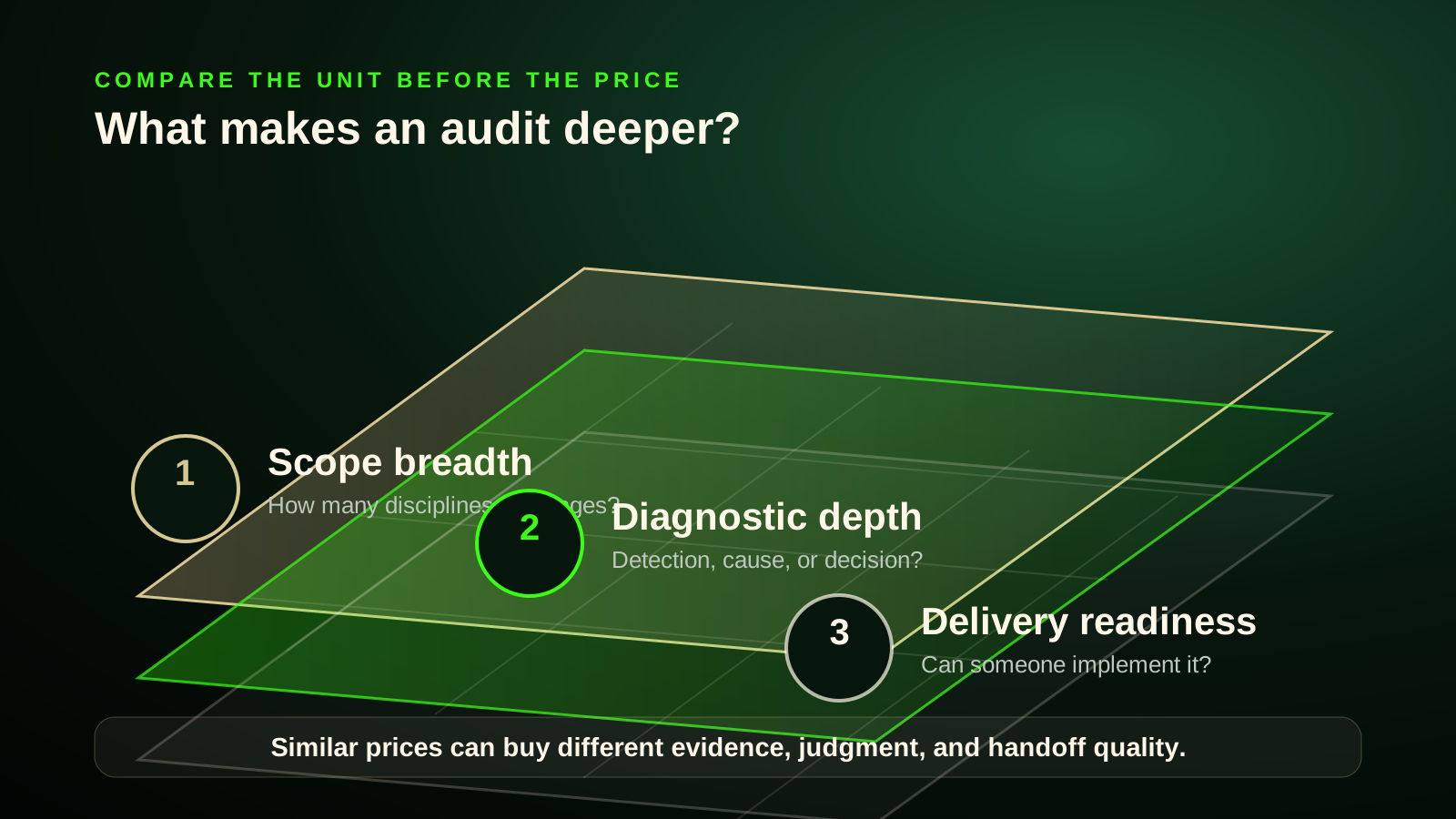
Quick answer Do not compare website audits by price until you normalize three dimensions: scope breadth × diagnostic depth × delivery readiness. Then check the evidence boundary, human-review boundary, implementation boundary, and what decision the audit is supposed to make easier.
Current as of: Public provider examples, platform documentation, and standards references were checked August 27, 2026. Audit packages, prices, currencies, platform features, and legal requirements can change. Recheck volatile details before buying or publishing an updated comparison.
“Website audit” is a label, not a standardized product
There is no universal commercial specification that says a website audit must include the same pages, methods, disciplines, tools, or deliverables from one provider to the next.
The phrase can describe:
- a free automated scan;
- a technical SEO crawl;
- a content or search-intent review;
- a user-experience review;
- an accessibility evaluation;
- a performance investigation;
- a conversion or lead-path diagnosis;
- an analytics and tracking review;
- a local-search audit;
- a Google Ads landing-page readiness review;
- a multi-disciplinary website diagnosis;
- a migration or website-purchase due-diligence engagement.
Those are not different prices for the same object. They are different objects wearing the same nametag.
A useful buyer-side definition is:
A professional website audit is a bounded diagnostic engagement that gathers evidence about a website or online presence, interprets that evidence against technical standards and business goals, prioritizes material findings, and explains what should happen next.
That definition still allows different audit types. It also draws a line between a diagnosis and a raw tool export.
Use the three-axis audit model
A single “basic to premium” ladder is too crude. A focused accessibility audit can be narrow but extremely deep. A broad “360 audit” can touch twelve categories while barely investigating any of them.
Compare audits on three independent axes.
| Axis | Low end | Middle | High end |
|---|---|---|---|
| Scope breadth | one page, signal, or narrow question | one specialist discipline | multi-disciplinary site and business system |
| Diagnostic depth | automated detection | human expert interpretation | account data, behavioural evidence, testing, or formal standards evaluation |
| Delivery readiness | score or issue list | prioritized recommendations | implementation-ready roadmap, ownership, dependencies, and verification conditions |
Scope breadth: how many questions are being investigated?
Breadth can include technical search health, content, UX, accessibility, performance, conversion paths, analytics, local visibility, platform limitations, and migration risk.
More breadth is not automatically better. If the problem is a sudden indexing decline, a focused technical SEO audit may be the right purchase. If the business cannot tell whether its problem is traffic quality, unclear services, mobile friction, broken measurement, or weak follow-up, broader diagnosis may be justified.
Diagnostic depth: how far does the work go beyond detection?
Depth is the difference between:
“The page has three H1 elements.”
and:
“The template creates repeated page-level headings across 42 service URLs. The markup is technically inconsistent, but the larger search problem is that the pages also target overlapping intent. Fix the template once, then consolidate the duplicated page strategy.”
The first is a condition. The second is a diagnosis with a root cause and an action path.
Delivery readiness: what can somebody do with the result?
A report can be technically accurate and still be useless to the buyer.
Delivery readiness increases when the audit explains:
- what was observed;
- where it occurs;
- why it matters;
- how confident the auditor is;
- what should change;
- who or what skill is needed;
- what depends on the change;
- how to verify that the correction worked.
That final layer often explains why two audits with similar research depth have different prices. One ends with recommendations. The other does the translation work required for implementation.
What different website audits actually examine
The categories overlap, but each has a different central question.
| Audit type | Central question | Typical evidence | What it does not automatically prove |
|---|---|---|---|
| Automated website scan | What machine-detectable conditions exist? | crawl data, HTML, headers, lab tests, rule-based checks | business impact, buyer confusion, full accessibility, or the correct strategic fix |
| Technical SEO audit | Can search engines crawl, render, interpret, and index the intended pages? | status codes, redirects, canonicals, robots, sitemaps, internal links, rendering, duplication | that content deserves to rank or will generate leads |
| Content/search audit | Do pages satisfy useful search and buyer intent? | page inventory, query mapping, titles, headings, gaps, overlap, stale content, internal links | technical crawl health or user behaviour without additional evidence |
| UX audit | Can intended users understand and operate the interface? | heuristic review, task flows, navigation, mobile, forms, possibly user testing | how all real users behave when no user testing occurred |
| Accessibility audit | Can people with disabilities perceive and operate the site, and how does it map to WCAG? | automated checks plus keyboard, focus, labels, semantics, contrast, reflow, contextual and possibly assistive-technology review | conformance when only an automated score was used |
| Performance audit | What causes slow loading, unstable layout, or delayed interaction? | field data where available, lab traces, network/runtime analysis, assets, scripts, fonts | that speed is the only reason leads or rankings are weak |
| Conversion/CRO audit | What may be stopping qualified visitors from acting? | offer, proof, CTA hierarchy, forms, analytics, recordings, funnels, experiments | causal certainty when the audit is only heuristic |
| Analytics/tracking audit | Are meaningful business actions being measured accurately? | GA4, GTM, Google Ads, call/form/booking events, attribution and account settings | complete data quality without account access and end-to-end testing |
| Local-search audit | Can the business be understood and surfaced for relevant local demand? | website/location structure, Google Business Profile, reviews, services, local queries | that distance can be overcome or rankings guaranteed |
| Paid-landing-page audit | Does the destination match the ad intent and measure the intended action? | query/ad/page continuity, mobile usability, proof, forms/calls, conversion actions | that the campaign targeting and bidding are otherwise healthy |
| Multi-disciplinary audit | What is materially wrong, what should be preserved, and what intervention is justified? | several evidence types integrated with business context | unlimited specialist depth in every discipline unless explicitly scoped |
A serious proposal should name the disciplines instead of hiding behind “50-point,” “360,” “complete,” or “premium.” Those labels tell you almost nothing about method.
Automated detection and human diagnosis are different jobs
Automation is not the enemy. It is excellent at repetitive evidence collection.
A crawler can inspect large numbers of URLs for broken links, redirects, metadata patterns, headings, canonicals, directives, structured data, crawl depth, orphan-page clues, and response codes. Lighthouse can identify many performance, accessibility, SEO, and best-practice conditions. Automated systems can save enormous amounts of time.
The limitation appears when the question changes from:
What measurable condition exists?
into:
What does this mean for this business, how serious is it, and what should happen first?
That second question requires context.
A tool can detect that an image has an alt attribute. It cannot always decide whether the text accurately communicates the image’s purpose in context. W3C explicitly states that automated tools cannot establish accessibility conformance on their own; knowledgeable human evaluation is required.
A crawler can detect forty pages with duplicate title patterns. It cannot automatically know whether the correct intervention is rewriting forty pages, consolidating ten page families, repairing one template, or deleting an obsolete location strategy.
A tag debugger can detect that a form event fires. It cannot prove by itself that the submitted inquiry reached the right inbox, was counted once, represented a qualified lead, and was useful to the business.
The right distinction is not automation versus human. It is:
detection → interpretation → business priority → implementation → verification
Different audit products stop at different points in that chain.
A good finding has anatomy—not just a warning
Use this model to inspect a sample audit deliverable.
| Layer | What the audit should show |
|---|---|
| Observation | The exact condition found |
| Evidence | URL, screenshot, crawl row, metric, configuration, test result, or reproducible path |
| Interpretation | What the condition likely means in context |
| Business impact | What customer, search, measurement, or operational outcome may be affected |
| Confidence | How certain the diagnosis is and what evidence is missing |
| Priority | Why this belongs before or after other work |
| Recommendation | The specific correction or next investigation |
| Dependency/owner | Who or what system is required |
| Verification | How the buyer can prove the work is complete |
For example:
Finding: The quote-form success event is not firing. Evidence: Three controlled submissions reached the inbox; no corresponding Google Ads conversion appeared; GTM Preview showed the trigger condition never matched. Business impact: Paid campaigns may be optimizing without form-lead data. Confidence: High. Priority: High if forms are a primary lead path. Recommendation: Correct the trigger, publish the container, submit a test lead, and verify one conversion in the relevant account.
Compare that with:
“Improve conversion tracking.”
The second statement is not implementation-ready. It barely qualifies as advice.
Keep severity, impact, and confidence separate
Many reports collapse every dimension into one colour or score. That destroys useful information.
A condition can be technically severe but commercially irrelevant to the current business. Another can be hard to prove but potentially expensive.
Use separate fields:
- technical severity — how broken is the condition itself?
- business impact — what could it cost or block?
- diagnostic confidence — how strongly does the evidence support the interpretation?
- priority — when should it be addressed relative to other work?
A broken canonical on a retired campaign page may be technically real and commercially minor. Generic hero wording on a high-traffic service page may have high potential impact but only medium diagnostic confidence without behavioural testing.
A good audit can say both things honestly.
What should you receive for your money?
A legitimate paid audit should normally make these items visible in the proposal or final deliverable.
The boundary
- pages, templates, profiles, locations, campaigns, or funnels included;
- disciplines included and excluded;
- whether “full site” means every crawlable URL or representative templates;
- whether account access is required;
- important questions the audit cannot answer.
The method
- tools used;
- automated checks performed;
- manual review performed;
- whether user testing, analytics, recordings, interviews, or formal accessibility procedures are included;
- current-as-of date for volatile platform claims.
The evidence
- exact affected URLs or flows;
- screenshots, crawl data, metrics, account settings, or test receipts;
- clear labels separating fact, inference, hypothesis, and recommendation;
- grouped root causes instead of hundreds of duplicated rows.
The decision support
- priority and rationale;
- what should be preserved;
- what can be fixed directly;
- what needs more evidence;
- what intervention level is justified;
- dependencies, effort, or skill requirements where reasonably knowable.
The commercial boundary
- whether implementation is included;
- whether copy, design, development, remediation, migration, or verification is separate;
- whether follow-up Q&A is included;
- whether the audit fee is credited toward later work;
- what can increase the quoted price.
A PDF page count is not on this list because length is not value. A 140-page export can contain less decision support than a fifteen-page report built around evidence and priority.
What should a website audit cost?
The research did not find a trustworthy Canada-wide average that normalizes generic website audits by method, hours, disciplines, depth, and deliverables.
That absence matters. Publishing one average would imply that the products are comparable when they are not.
The current provider sample supports comparison classes, not a market price law.
| Comparison class | Published observations in the August 2026 sample | What the buyer is generally buying | Main caution |
|---|---|---|---|
| Automated or free screen | free | quick detection, score, limited priorities, or triage | not equivalent to complete diagnosis |
| Productized micro/hybrid review | roughly C$97–C$500 in current examples | bounded crawl, selected pages, some manual checks, quick-win priorities | depth varies dramatically within the band |
| Focused specialist audit | many sampled Canadian examples around C$500–C$1,500 | SEO, content, CRO, UX, local search, accessibility, or another specialist question | discipline and manual depth matter more than label |
| Broad multi-disciplinary diagnosis | transparent sampled examples beginning around C$2,500–C$3,000 | several disciplines integrated into one strategic diagnosis | page/site boundary may still be small |
| Formal, complex, or specialized engagement | current examples from roughly C$2,195 to C$8,000+, with formal accessibility work potentially higher | acquisition due diligence, complex systems, large ecommerce, formal accessibility or high-risk evidence | fundamentally different from a normal small-business marketing audit |
These are observed published examples checked August 27, 2026, not statistical averages, recommended prices, or promises about quality.
A C$500 productized specialist audit may be more useful than a C$3,000 report if the smaller product has a clear boundary, strong evidence, ranked actions, exact implementation guidance, and a good fit for the buyer’s problem. Price does not rescue vague methodology.
At the same time, a formal accessibility evaluation, multi-market technical investigation, ecommerce diagnosis, user-testing engagement, or acquisition due-diligence review can legitimately cost much more because the evidence burden and risk are different.
What actually drives the price
A better pricing model is:
Price ≈ boundary × discipline breadth × diagnostic depth × complexity + evidence burden + delivery readiness + testing/follow-up
Boundary
One page, five templates, one conversion path, one location, every URL, or a representative sample are different scopes.
Breadth
Technical SEO alone is not the same labour mix as technical SEO + content + UX + accessibility + conversion + analytics.
Depth
Automated collection, expert interpretation, account-data analysis, user testing, assistive-technology review, and experimentation require different levels of effort.
Complexity
JavaScript rendering, ecommerce, multiple languages, multiple locations, faceted navigation, legacy CMS behaviour, integrations, and unusual templates increase diagnostic work.
Evidence burden
Screenshots, reproducible steps, crawl exports, query maps, analytics reconciliation, call/form tests, interview notes, and formal evaluation procedures take time.
Delivery readiness
An issue list is cheaper to produce than developer tickets, copy recommendations, page maps, dependencies, effort bands, acceptance conditions, and retesting.
Follow-up and implementation
Audit-only, audit plus consultation, audit plus remediation, and audit plus post-change verification are different products.
That is why two five-page audits can differ by thousands of dollars without either price automatically being absurd.
Free audit versus paid audit is the wrong comparison
“Free” describes the commercial model, not the methodology.
A free audit may be:
- an automated scanner;
- a limited homepage or landing-page review;
- a human triage session;
- a lead-qualification tool;
- a few quick wins designed to establish whether deeper work is justified.
Some free reviews are useful. Many are also sales funnels. Those two facts can both be true.
The better question is:
What work happens after I submit the URL, and what decision is this review deep enough to support?
A free first read can be enough to identify a broken form, unclear first screen, missing service page, weak mobile contact path, or obvious indexing mistake. It is not enough to claim complete accessibility conformance, diagnose a complex search decline, map an entire redesign, or prove conversion causality.
The ethical boundary is simple: limited triage should be sold as limited triage.
When a paid audit earns its cost
A paid diagnosis is most defensible when choosing the wrong next move could cost more than the audit.
Strong cases include:
- traffic exists but lead generation is weak and the failure point is unclear;
- search visibility or indexing declined;
- several systems may be involved;
- the business is considering a redesign, rebuild, or platform migration;
- valuable URLs, backlinks, content, analytics, or conversion paths need preservation;
- Google Ads will send paid traffic into an unproven destination;
- analytics, forms, calls, bookings, or CRM handoffs may be misconfigured;
- the site has enough traffic for behavioural evidence;
- accessibility needs specialist evaluation beyond automation;
- content has grown without a clear information architecture;
- stakeholders need a defensible roadmap before approving spend.
A useful audit can conclude:
- fix one defect;
- repair several paths;
- refresh content;
- restructure pages;
- gather more evidence;
- build one campaign landing page;
- migrate the platform;
- rebuild the site;
- leave the healthy parts alone.
If every audit from a provider ends with “buy our biggest redesign,” the diagnosis is not demonstrating much independence.
When an audit may be unnecessary
Do not buy a large diagnosis for an isolated problem you already understand.
Examples:
- two broken contact links on a five-page site;
- one incorrect phone number;
- one obsolete service paragraph;
- a known form-routing defect;
- a simple metadata correction;
- a tiny new site with no meaningful traffic, no search history, and no complex migration risk.
That does not mean audits are useless for small sites. It means the audit should be proportionate to the uncertainty.
A CRO audit also becomes less data-rich when the site has almost no traffic. The provider can still perform expert review, but it should label hypotheses as hypotheses rather than pretending to have behavioural proof.
Finally, an audit is poor value when the business has no ability or intention to implement anything. A report that sits in a folder is not an operating improvement.
Accessibility and security need explicit boundaries
Two labels deserve extra skepticism.
“Accessibility checked”
Ask whether the engagement includes only automated tests or also knowledgeable human evaluation.
Automation can detect many failures. It cannot establish complete conformance by itself. Ask which WCAG version and level are being evaluated, whether keyboard/focus/form/contextual checks are included, and whether the provider is offering technical findings or making a legal-compliance claim.
W3C recommends WCAG 2.2 as the current standards reference. Ontario legal requirements may reference different versions and apply only to covered organizations. Treat legal applicability as a separate question and obtain appropriate legal guidance when required.
“Security audit”
Ask what the term means.
HTTPS, mixed-content, public headers, exposed configuration, and observable browser warnings can be useful marketing-site readiness checks. They are not the same thing as penetration testing, authenticated vulnerability assessment, dependency review, server hardening, or application-security testing.
A provider should not use one label to imply the other.
Red flags in an audit offer
Watch for:
- a generic scanner export sold as complete consulting without disclosure;
- no exact page, template, profile, campaign, or discipline boundary;
- “full site” with no definition;
- no distinction between automated and manual work;
- no evidence trail;
- no prioritization;
- everything labelled critical;
- a proprietary score presented as Google truth;
- guaranteed rankings, revenue, compliance, or conversion uplift;
- automated accessibility checking presented as conformance certification;
- a public header scan marketed as penetration testing;
- UX or CRO certainty without user or behavioural evidence;
- implementation implied but not stated;
- no current-as-of date for volatile claims;
- no mention of limitations or missing account access;
- every recommendation leading to the seller’s largest package.
Google explicitly warns businesses against guaranteed rankings, and Google stated in June 2026 that third-party SEO tools do not possess privileged access to Google’s internal ranking data. Third-party metrics can still help prioritize work; they are not secret Search truth.
Twenty questions to ask before buying
- What exact problem is this audit designed to answer?
- Which pages, templates, profiles, locations, campaigns, or funnels are included?
- Does “full site” mean every URL or a representative sample?
- Which disciplines are included and excluded?
- What is automated?
- What receives manual human review?
- Who performs the manual review, and what is their specialty?
- What account access is required?
- What can you not conclude without that access?
- Does UX mean heuristic review, user testing, or both?
- Does accessibility include manual standards-based evaluation?
- Does conversion analysis use behavioural evidence or mainly expert judgment?
- Will every material finding include evidence and an affected location?
- How are technical severity, business impact, confidence, effort, and priority separated?
- Will repeated defects be grouped by root cause?
- Will recommendations say exactly what should change?
- Can a developer, designer, or writer implement the report without another discovery project?
- Is implementation included, separate, or credited later?
- Is follow-up or post-fix verification included?
- What decision will I be able to make afterward that I cannot make today?
That last question cuts through most sales language. It forces the provider to explain the economic purpose of the audit.
A fast way to normalize competing quotes
Create one comparison sheet with these columns:
| Comparison field | Audit A | Audit B | Audit C |
|---|---|---|---|
| Decision supported | |||
| Pages/templates/funnels | |||
| Disciplines | |||
| Automated work | |||
| Manual work | |||
| Account data required | |||
| Evidence included | |||
| Prioritization method | |||
| Implementation detail | |||
| Remediation included | |||
| Verification included | |||
| Follow-up included | |||
| Current price/currency |
Only compare price after filling those rows. Empty cells are not minor details; they are unanswered scope.
Useful next step
Write one sentence describing the decision you need the audit to support.
Examples:
- “We need to know why traffic is not producing qualified inquiries.”
- “We need to know what must be preserved before migrating platforms.”
- “We need to decide whether to repair, redesign, rebuild, or leave the site alone.”
- “We need to know whether this landing page is ready for paid traffic.”
Then ask each provider to map its boundary, evidence, deliverable, implementation, and verification to that decision.
Use the website redesign versus new website diagnostic when the unresolved question is intervention depth. Use the pre-rebuild website checklist after the intervention has been chosen and the project is moving toward implementation.
When the cause is still unclear, a website audit should produce evidence and priorities, not a giant warning count.
Source notes
This article was rebuilt from the Synapse Research Notes source pass checked August 27, 2026. The provider prices below are used as observed examples of current scope classes, not as a statistically representative market average or a guarantee of quality.
- W3C: Evaluating Web Accessibility Overview and Selecting Web Accessibility Evaluation Tools — human-evaluation boundary and limits of automated accessibility checking.
- W3C: Easy Checks and WCAG 2 Overview — contextual evaluation and current standards reference.
- Google Search Central: SEO Starter Guide, robots.txt, sitemaps, and canonicalization — technical-search boundaries.
- Google Business Profile: Improve your local ranking — relevance, distance, and prominence context.
- Chrome: Lighthouse overview — automated audit capabilities and performance-tool context.
- Screaming Frog SEO Spider — current crawler capability examples.
- Nielsen Norman Group: Heuristic Evaluation and Usability 101 — expert review versus actual usability evidence.
- Coastal Signal services, JPL Digital SEO Audit Sprint, Stature Marketing website audits, Storyteller Media content audit, and Flamingo Marketing web design services — selected public Canadian scope and pricing examples checked August 27, 2026.
- Google Search Central: Do you need an SEO? — ranking-guarantee warning.
All provider prices, free-audit offers, Google platform terminology, performance tooling, Ontario accessibility requirements, and Synapse route state should be rechecked before a material update.