
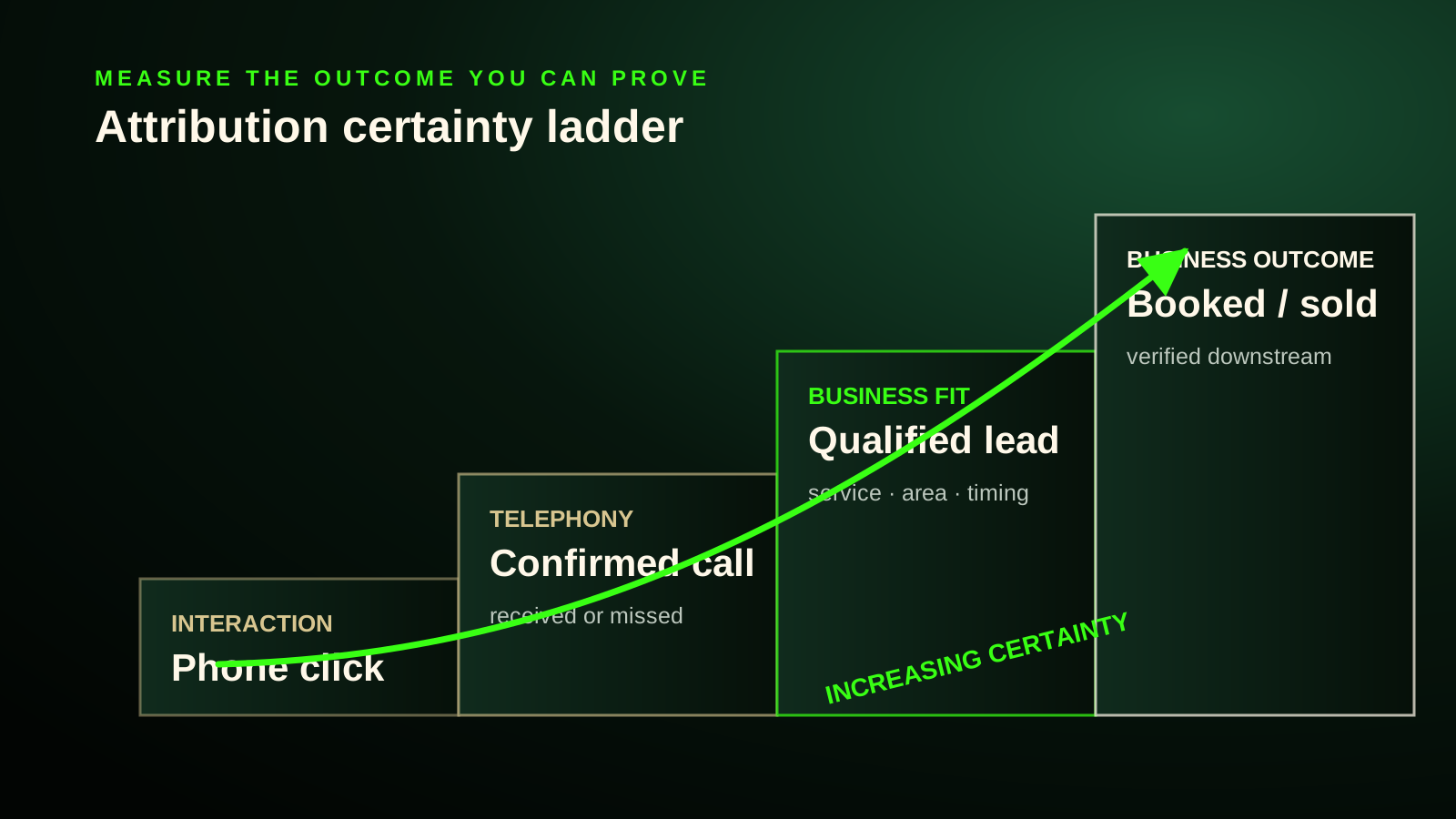
A dashboard can report twelve “phone conversions” while the business remembers six calls, answered four, qualified two, and sold one job.
That does not automatically mean the tracking is broken. It may mean the dashboard, telephone network, and business are measuring different stages of the same journey.
Quick answer Use an attribution-certainty ladder: phone click → telephony-confirmed call → qualified lead → booked or quoted opportunity → sale. A phone-number click proves intent. A Google forwarding-number call proves a tracked phone event occurred. Only the business or CRM can prove the caller was qualified, booked, or sold.
Current as of: Google Ads call reporting, Google forwarding numbers, AI-qualified calls, offline lead measurement, and Canadian privacy guidance were checked August 27, 2026. This is a high-volatility platform topic. Recheck the live Google Ads account, current Help documentation, recording controls, and applicable legal/privacy requirements before implementation.
The five-stage call measurement ladder
The first job is to stop using click, call, lead, and sale as synonyms.
| Stage | What happened | What the evidence can support | What it cannot support yet |
|---|---|---|---|
| Phone click | Visitor selected a phone link or button | The visitor showed call intent | That dialing occurred or connected |
| Telephony-confirmed call | A forwarding or call-tracking layer observed a phone call | A trackable call event occurred | That the caller was suitable |
| Qualified lead | Business confirmed service, location, identity, timing, and commercial fit | The call was a usable sales opportunity | That an appointment or job was secured |
| Booked / quoted opportunity | Appointment, estimate, consultation, or quote progressed | The lead moved into real pipeline | That revenue was won |
| Sale / revenue | Job sold, client retained, deposit paid, or revenue recorded | The ad-attributed opportunity created business value | That every upstream interaction deserves equal credit |
A useful reporting system keeps those rows separate.
A weak reporting system takes the easiest event to collect—usually a phone click or any call over a threshold—and labels it “lead.” That can make the campaign look better than the business outcome and can teach automated bidding to chase the wrong success signal.
The practical question is not:
How many phone conversions did Google report?
It is:
Which stage does each reported number represent, and what evidence supports that label?
The attribution-certainty ladder
There are different levels of confidence behind a “Google Ads phone lead.”
Level 1: browser interaction
A tel: click says the visitor pressed a call control.
It does not prove:
- the dialer opened successfully;
- the visitor pressed Call;
- the telephone network connected;
- the business answered;
- the conversation was useful;
- the caller booked or bought.
Google’s own mobile phone-number-click documentation explicitly says that this method tracks the click rather than the actual phone call.
Level 2: telephony evidence
A Google forwarding number or third-party tracking number can establish that a call passed through a telephone tracking layer.
Depending on the system, that can add:
- start time;
- duration;
- missed or received status;
- caller geography or number where available;
- campaign, ad group, source, or keyword;
- recording or transcript where enabled;
- routing and repeat-caller context.
That is much stronger evidence than a browser click.
It still does not prove the call was a real lead. A robocall, wrong number, existing customer, vendor, job seeker, out-of-area caller, and ideal new customer are all telephony-confirmed calls.
Level 3: business qualification
The business determines whether the caller is commercially useful.
Typical qualification fields include:
- new customer or existing customer;
- requested service;
- location or service-area fit;
- urgency;
- project size or suitability;
- reachable contact information;
- appointment, estimate, or consultation status;
- disqualification reason.
This stage is normally stored in a CRM, job-management system, call-tracking platform, or disciplined spreadsheet—not inferred reliably from call length alone.
Level 4: pipeline outcome
A qualified lead becomes:
- appointment booked;
- estimate scheduled;
- consultation attended;
- quote sent;
- deposit paid;
- job sold;
- customer revenue.
This is the stage that tells the business whether the advertising produced value.
The higher the evidence level, the more useful it becomes for budget, bidding, and sales decisions—and the more operational discipline the business has to maintain.
What Google Ads can measure natively in Canada
Native Google Ads phone measurement is not one feature. It contains several paths with different evidence strength.
As of August 27, 2026, Canada is explicitly listed as a Google Forwarding Number country, including local and toll-free number capability, subject to normal account and feature eligibility.
| Native method | What triggers it | What it actually proves |
|---|---|---|
| Calls from eligible ads or call assets | Caller uses the phone path shown with the ad and call reporting | Google observed a call through its forwarding/reporting path |
| Calls from website visits | Ad visitor reaches the site, sees a substituted Google forwarding number, and calls it | Google observed a phone call after the paid website visit |
| Mobile website phone-number click | Visitor taps a linked phone number | A browser click occurred—not a confirmed call |
| Ad-interaction fallback | Google lacks a forwarding-number telephony signal and uses available interaction evidence | Estimated/classified conversion evidence, not telephony proof |
| Imported call or offline outcome | External system reports that a call became a qualified lead, sale, or other valuable result | A downstream business event was matched back to advertising |
The default setup should follow the business’s real call path.
A phone-first emergency advertiser may get many direct calls from call assets.
A contractor selling a considered project may receive more calls after a visitor reads the service page, reviews work, checks location fit, and then phones.
The two calls may both come from Google Ads, but they require different tracking paths.
Calls directly from the ad versus calls after a website visit
Calls directly from an ad or call asset
The chain is roughly:
``text Search → ad / call asset → Google forwarding number → real business number ``
With eligible call reporting, Google can associate the telephone event with the advertising context and report details such as campaign, ad group, timing, duration, and received/missed status.
This path is useful when the caller does not need the website first.
Examples:
- urgent repair;
- towing;
- same-day appointment;
- emergency service;
- known brand or repeat intent;
- simple high-intent service question.
Call assets should be scheduled around times when the business can actually handle calls. An ad generating a missed call can be working at the advertising stage while failing at the intake stage.
Calls after the person reaches the website
The chain is:
``text Search → ad click → website → displayed business number becomes a Google forwarding number → call → real business number ``
The forwarding number preserves attribution between the earlier ad click and the later telephone call.
This path is useful when people normally need to inspect:
- service details;
- service area;
- project proof;
- reviews;
- process;
- pricing orientation;
- eligibility;
- contact expectations.
Google’s current website-call documentation states that eligible website calls can be measured for up to 60 days after the original ad click. That does not mean Google automatically knows about every later call to the ordinary business number. Native certainty still depends on the forwarding or supported offline-matching path.
For deciding whether the click should reach a homepage, service page, or dedicated paid page, use the Google Ads landing page versus homepage guide.
What a Google forwarding number is—and is not
A Google forwarding number is an intermediary tracking number.
It:
- appears in eligible Google Ads call-reporting or website-call contexts;
- forwards to the advertiser’s real business number;
- lets Google associate call details with the ad interaction;
- may use a local area code or toll-free number where available;
- is owned and controlled by Google;
- can change or be reassigned.
It is not:
- a new permanent business number;
- a number to print on signs, vehicles, cards, or directories;
- a number to make the canonical phone identity in Google Business Profile;
- guaranteed to remain assigned forever;
- proof that every caller was a qualified lead.
Google says forwarding numbers should not be promoted outside the supported tracking contexts. The business should keep its real, business-controlled number as its canonical identity.
Saved and repeat calls have special routing behaviour
The source research identified two current edge cases worth understanding without building the whole article around them.
If someone sees a forwarding number but does not call it immediately, the first later call generally has a short routing window—about 30 minutes, or up to roughly two hours in certain markets according to current Google documentation.
After someone successfully calls the forwarding number, Google documents repeat routing for 60 days, with that period resetting when the number is called again.
Those are routing behaviours. They are not permission to count every repeat call as a new lead. Repeat callers, existing customers, support calls, and follow-up conversations still need deduplication and business classification.
The 2026 qualified-call model made duration-only advice stale
Older call-tracking tutorials often teach a simple rule:
Count every call longer than 30, 60, or 90 seconds as a conversion.
Duration can be useful. It is not the whole current model.
Google’s 2026 AI-qualified-call documentation describes a hierarchy:
- call recording can be the primary qualification signal where available;
- duration can be a fallback when the recording cannot be evaluated;
- ad-interaction information can be a further fallback when a Google forwarding number is unavailable.
Google also currently says call recording is on by default in this system, subject to listed exceptions, and that recording eligibility requires both the dialing and receiving numbers to be in the United States or Canada.
These are volatile platform facts. They should not be turned into a promise that every Canadian account, campaign, vertical, or interface exposes identical behaviour.
Why call duration is still only a proxy
A long call can be:
- a real estimate request;
- an existing customer needing support;
- a vendor sales pitch;
- an out-of-area caller;
- a wrong number;
- a robocall stuck in a menu;
- a poor-fit person asking many questions.
A short call can be:
- a wrong number;
- a caller hanging up;
- a dispatcher booking an urgent service in 25 seconds;
- a customer confirming a location or appointment.
Choose duration thresholds from actual call history, menu/greeting length, staff input, and lead outcomes. Do not copy a universal “60 seconds equals lead” rule from a tutorial.
What Google Call Details can prove
For eligible calls that pass through Google forwarding-number reporting, current documentation says the Call Details report can contain fields such as:
| Field | What it helps answer |
|---|---|
| Call start time | When did the phone event happen? |
| Duration | How long did the tracked call last? |
| Missed / received | Did the business answer? |
| Caller country or area code | Where did the call appear to originate? |
| Caller number where available | Can the business reconcile the call with its records? |
| Call source and type | Which Google phone path produced it? |
| Campaign and ad group | Which campaign context received credit? |
| Search keyword where supported | Which managed keyword was associated? |
| Recording where eligible | Can the call be reviewed or classified? |
That report can answer:
Did a trackable call occur, when, from which advertising context, and was it missed or received?
It cannot answer reliably without downstream evidence:
Was the caller inside our service area, asking for the right service, qualified, booked, quoted, sold, or profitable?
Native reporting is attribution evidence. The business outcome belongs in the intake and CRM system.
GA4 and Google Ads are measuring different layers
GA4 is a web and app event system. Google Ads call reporting adds telephony evidence.
What GA4 can measure cleanly
GA4 can record an event when someone:
- clicks a phone link;
- reaches a contact page;
- submits a form;
- completes a booking flow;
- performs another instrumented website action.
A phone-click event is useful for understanding CTA use and page behaviour.
It remains a click.
What Google Ads call reporting adds
With forwarding-number call reporting, Google Ads can add:
- a phone call through the tracking layer;
- duration;
- missed/received state;
- advertising attribution;
- current call-qualification logic;
- call detail fields.
That is why “GA4 shows 20 phone clicks” and “Google Ads shows 11 calls” can both be correct.
Some people clicked and cancelled. Some calls used a different path. Some events were blocked or attributed differently. The systems may use different conversion definitions, windows, date assignments, and settings.
Why the totals should not be forced to match
Possible legitimate differences include:
- browser click versus telephony event;
- GA4 key event versus native Ads call conversion;
- click-date versus conversion-date reporting;
- different attribution settings;
- primary versus secondary conversion treatment;
- duplicate imported and native actions;
- lost identifiers, redirects, consent, or tag failures;
- calls made outside the tracked forwarding path.
The goal is not identical totals. It is a reconciled explanation of what each total represents.
The source pass found documentation drift around old Universal Analytics “Phone Analytics” references. Do not assume GA4 natively provides every telephone detail available in Google Ads Call Details. Verify the actual 2026 property and account instead of inheriting an old tutorial.
Primary and secondary conversions decide what Google optimizes
Tracking an event and bidding toward it are different decisions.
A simple conversion architecture for a call-heavy business might look like this:
| Action | Early account role | Mature account role |
|---|---|---|
tel: click | Secondary diagnostic | Secondary diagnostic |
| Calls from ads | Primary when real calls are the best available signal | Secondary once stronger downstream data has enough volume |
| Website call conversion | Primary when calls are the best available signal | Secondary or supporting signal later |
| Qualified phone lead | Not available until business classification exists | Primary when imports are reliable and timely |
| Booked estimate / appointment | Optional later-stage signal | Strong primary for many service businesses |
| Sold job / retained client | Sparse or unavailable at launch | Highest business-value signal when volume and timing support it |
A weak phone-click event should not casually sit beside a qualified lead as an equal “conversion.”
Google’s primary/secondary settings matter because primary actions are normally the actions used in the main conversion reporting and bidding goals, while secondary actions are retained for observation unless deliberately pulled into a custom goal.
Bad measurement can therefore damage more than reporting. It can teach Smart Bidding to find more people who perform the easiest cheap interaction instead of more people who become suitable work.
Connect calls to qualified leads, bookings, and sales
The business needs a downstream record.
It does not require an enterprise CRM on day one. A disciplined spreadsheet can be enough if somebody actually maintains it.
Minimum call outcome fields
Record:
- call date and time;
- caller number or call ID where available;
- source/campaign/ad group where available;
- missed or received;
- new or repeat caller;
- requested service;
- city/postal code/service-area fit;
- qualified or disqualified;
- disqualification reason;
- booked appointment or estimate;
- quote sent;
- won or lost;
- revenue or value where appropriate;
- owner and next action.
A practical status taxonomy
| Status | What it means | Should it train bidding? |
|---|---|---|
| Missed call | Opportunity reached the phone path but was not answered | Usually operational/secondary |
| Wrong number / spam / robocall | Not a business lead | No |
| Existing customer support | Not net-new acquisition demand | Usually no |
| Wrong service | Caller wants something not offered | No |
| Wrong location | Outside real service area | No |
| Valid raw inquiry | Real new contact but fit not yet confirmed | Temporary launch signal |
| Qualified lead | Correct service, area, and commercial fit | Strong mature signal |
| Booked appointment / estimate | Qualified opportunity progressed | Strong signal |
| Quote accepted / deposit paid | Commercial commitment | Very strong signal |
| Sold job / retained client | Closed business outcome | Strongest business-value signal |
Google supports offline qualified- and converted-lead stages and currently recommends enhanced conversions for leads for advertisers building a modern offline feedback process.
The implementation burden is real: the business has to capture identifiers, update statuses, avoid duplicates, and upload outcomes accurately and promptly enough to help reporting and bidding.
A fake closed-loop dashboard is worse than an honest raw-call system because it pretends the data discipline exists when it does not.
When native Google tracking is enough
Native Google Ads tracking is usually enough when the business mainly needs to know:
- whether Google Ads produced the call;
- which campaign or ad group was involved;
- whether the call was missed or received;
- how long it lasted;
- whether it met the current qualification rule;
- whether later qualified or sold outcomes can be imported.
This is a strong starting point for a small Canadian advertiser because Google forwarding numbers are currently available in Canada.
Good fit for native tracking
- Most paid demand comes from Google Search.
- One business or small location set receives the calls.
- The core question is Google campaign attribution.
- The business can review call outcomes manually.
- Cross-channel session attribution is not yet necessary.
- Existing Google Ads and CRM/Sheets workflows can handle the data.
Native tracking has also become more capable with call details, recordings where eligible, AI qualification, and offline outcome support.
Do not buy another platform merely to feel sophisticated.
When third-party call tracking earns the extra complexity
A third-party call platform becomes justified when the decision problem expands beyond Google Ads.
Typical reasons include:
- attribution across Google Ads, organic, direct, social, directories, offline campaigns, or other channels;
- visitor/session-level dynamic number insertion;
- number pools for keyword or session attribution;
- richer recordings, transcripts, tags, scoring, and coaching;
- CRM routing and workflow automation;
- multi-location or multi-team call distribution;
- repeat-caller history;
- centralized phone operations and reporting;
- vendor integrations that native Google tracking does not provide.
| Requirement | Native Google | Third-party DNI / call platform |
|---|---|---|
| Google Ads campaign attribution | Strong | Strong |
| Calls from Google Ads website visitors | Strong with GFN setup | Strong with supported integration |
| Cross-channel attribution | Limited by Google ecosystem/context | Core use case |
| Visitor/session tracking pool | Google forwarding path | Common advanced feature |
| Missed/received/duration | Available | Usually available |
| Recording/transcription | Current eligible Google capabilities | Often deeper/customizable |
| CRM workflow | Offline conversion support | Often broader direct integrations |
| Lead tagging/coaching | Limited/current call intelligence | Common operational feature |
| Multi-location routing | Context dependent | Common product capability |
| Vendor cost/maintenance | Native platform complexity | Added subscription and operational dependency |
The decision rule is:
Add the third-party layer when it answers a defined cross-channel, session, routing, coaching, or CRM question that native Google reporting cannot answer well enough.
Dynamic Number Insertion does not automatically “hurt local SEO”
Dynamic Number Insertion changes the displayed number for a specific visitor or session while routing the call to the real business line.
The internet version of this discussion often becomes:
Call tracking numbers ruin NAP consistency and destroy local rankings.
The source research did not find primary Google evidence supporting that blanket penalty claim.
The real implementation boundary is more useful:
- keep a real business-controlled number as the canonical business identity;
- keep the Google Business Profile number accurate and controlled by the business;
- do not publish a temporary Google forwarding number as the permanent number;
- use dynamic replacement only in the intended tracking context;
- make sure crawlers and ordinary visitors can still identify the real business consistently;
- test how the script behaves across caching, consent, client-side rendering, and mobile call links.
A poorly implemented tracking number can create identity and operational problems. That is not the same thing as proving a universal ranking penalty for DNI.
Missed calls separate advertising performance from intake performance
Google Call Details can distinguish missed and received calls.
That creates a useful accountability split:
``text Ad generated call ├── received │ ├── qualified │ │ ├── booked / quoted │ │ └── not progressed │ └── unqualified └── missed ├── recovered by callback / text └── lost ``
An ad can succeed in creating the call while the business fails to answer it.
A high missed-call rate can indicate:
- call assets run outside staffed hours;
- owner or crew cannot answer while working;
- routing rings the wrong person;
- voicemail is unclear;
- no callback process exists;
- after-hours traffic has no alternative path;
- staffing or schedule does not match the campaign.
Do not classify those calls as “bad Google leads” without inspecting what actually happened.
Possible fixes include:
- scheduling call assets only during answerable hours;
- using a form, booking, SMS, or callback option after hours;
- setting a missed-call alert and callback owner;
- adding an answering service where economics justify it;
- separating emergency and planned-project campaigns;
- reporting answer rate and recovery rate beside call volume.
Implementation failures that make the dashboard lie
A setup can look correct in the page while failing in the actual call path.
| Failure | Result |
|---|---|
Visible number changes but the mobile tel: link does not | User dials the original number and bypasses the tracked forwarding path |
| Number configured in the tag does not exactly match the website digits | Replacement may fail |
| International formatting is handled incorrectly | Canadian number substitution can break or display badly |
| Google forwarding number is treated as permanent | Business identity and routing become fragile |
| Native call and imported call both count the same event | One call becomes multiple reported conversions |
tel: clicks are Primary while actual calls are not | Bidding optimizes toward phone-button taps |
| Minimum duration is copied blindly | Valid short calls are excluded or noisy calls included |
| Call asset schedule ignores answer coverage | Good intent becomes missed calls |
| Consent mode or tag configuration blocks the relevant script | Tracking becomes incomplete |
| Content Security Policy blocks tag resources | Number replacement or events fail |
| SPA/component updates replace the phone element after the tag runs | Substitution may fail on the live DOM |
| Google and third-party replacement scripts target the same number | Scripts can conflict or overwrite each other |
| GA4 and native Ads events represent the same outcome as separate Primaries | Totals and bidding signals inflate |
| Call-recording notice and retention are ignored | Privacy, legal, and trust risk |
The implementation-specific risks—SPAs, consent, caching, CSP, and competing scripts—must be tested on the real site. They should not be generalized into “React call tracking does not work” or “DNI always conflicts.”
Validate the complete path—not just the tag
A reliable test goes from the ad interaction to the downstream outcome.
Layer 1: conversion configuration
Confirm:
- the intended phone conversion actions exist;
- phone clicks, calls, and downstream outcomes have distinct names;
- Primary and Secondary status is intentional;
- count and qualification settings match the business model;
- duplicate native/imported actions are not both training bidding.
Layer 2: website substitution
Use Google’s current documented test procedure after activation:
- enter through an eligible ad click;
- confirm the business number changes to a Google forwarding number;
- inspect desktop and mobile;
- verify both the visible number and
tel:destination use the forwarding number; - confirm the final site number still routes to the correct business line.
Google notes that a live test click may incur a charge. Avoid repetitive casual testing on a live campaign.
Layer 3: telephony and reporting
Place the controlled call and confirm:
- the correct business phone rings;
- received/missed status is accurate;
- duration and timing appear;
- campaign/ad group/keyword attribution appears where supported;
- the call qualifies or does not qualify according to the current logic;
- recording status and notice align with the business’s policy.
Layer 4: business reconciliation
Compare:
- Google Call Details;
- the business phone log;
- call-tracking platform if one exists;
- CRM or spreadsheet record;
- appointment/quote/sale outcome.
One call should not silently become three conversions because it appears in native Ads, GA4 import, and offline import.
Layer 5: outcome feedback
When offline integration is in scope:
- mark the test call qualified or disqualified;
- progress it to a test booking or non-commercial test status without contaminating real revenue data;
- verify the correct later-stage action returns to Google Ads;
- confirm timestamp, identifiers, value, currency, and deduplication rules.
A technically firing tag is not the finish line. The finish line is a reconciled business event whose meaning is understood.
A maturity path for call-driven local businesses
Do not overbuild the stack on day one.
Level 1: phone CTA measurement
Use a tel: click event to understand whether visitors interact with the call control.
Good for: basic UX analysis.
Do not claim: completed calls or leads.
Level 2: native Google call reporting
Measure calls directly from ads and/or website calls through Google forwarding numbers.
Good for: Google Ads attribution, duration, missed/received state, current qualification logic.
Canadian fit: strong current baseline because Canada is GFN-eligible.
Level 3: manual quality review
Review calls and label service fit, geography, qualification, booked status, and outcome.
Good for: separating raw calls from usable leads without buying a large system.
Level 4: qualified/offline feedback
Import qualified leads, booked estimates, converted leads, or sold outcomes through a reliable Google-supported workflow.
Good for: teaching bidding about business value rather than easy calls.
Level 5: third-party cross-channel and operations stack
Add visitor-level DNI, number pools, cross-channel attribution, routing, transcripts, CRM automation, and coaching where justified.
Good for: mature call-heavy operations with multiple channels, locations, teams, or high lead value.
The usual serious path for a Canadian local Search advertiser is:
native calls from ads + native website call conversions → manual qualification → qualified/offline feedback.
Add third-party DNI when cross-channel or phone-operations requirements actually demand it.
Canadian recording and privacy boundary
Google’s current call-qualification system makes this impossible to treat as a footnote.
The current source says call recording can be on by default in eligible AI-qualified-call contexts and can be used for lead-quality evaluation, spam/fraud detection, and conversion reporting.
Do not reduce Canadian recording law and privacy obligations to:
Canada is one-party consent, so we are good.
That is not a complete operational analysis.
The Office of the Privacy Commissioner of Canada has advised organizations recording customer calls to inform callers, explain why the call is being recorded, and obtain meaningful consent appropriate to the situation. A real implementation also has to consider:
- who is recording;
- which calls are recorded;
- notice and consent language;
- purpose limitation;
- retention period;
- access and deletion processes;
- vendor storage and processing;
- cross-border data handling;
- security;
- staff access;
- healthcare, financial, legal, or other sector-specific obligations.
This article is not legal advice. A Canadian or Ontario business using recording, transcription, or AI call analysis should obtain current situation-specific advice and verify the live Google and vendor settings.
Call-tracking myths to stop repeating
| Myth | Better answer |
|---|---|
| “A phone click means a call.” | It proves a browser interaction, not a connected call. |
| “Every tracked call is a lead.” | A call still needs business qualification. |
| “A 60-second call is automatically qualified.” | Duration is a proxy; current Google qualification uses broader evidence where available. |
| “GA4 tracks every call generated by Google Ads.” | GA4 tracks web events; native telephony evidence comes from the call-reporting layer. |
| “Google Ads and GA4 should have identical totals.” | They may track different events, dates, attribution, and settings. |
| “Google forwarding numbers replace the real number everywhere.” | They appear in eligible tracking contexts and route to the real business line. |
| “Publish the Google forwarding number as the business number.” | Do not. It belongs to Google and can change. |
| “Call tracking always hurts local SEO.” | No blanket penalty was supported; preserve a genuine canonical business number and implement DNI carefully. |
| “Third-party call tracking is mandatory.” | Native Google is often enough for Google attribution; add third-party tooling for defined additional needs. |
| “Missed calls prove the ad traffic was bad.” | The ad may have generated real demand that the business failed to answer. |
| “More call conversions always improves bidding.” | More weak or duplicated conversions can train the wrong outcome. |
| “Recording is only a technical setting.” | It creates privacy, notice, retention, access, and vendor obligations. |
Useful next step
Take every phone-related metric in the account and force it into one row:
phone click → confirmed call → qualified lead → booked/quoted → sale
For each metric, write:
- exact conversion-action name;
- what triggers it;
- which system records it;
- whether it is Primary or Secondary;
- whether it can duplicate another action;
- what business decision it is safe to support.
Anything that cannot be placed confidently on that ladder should not guide spend until its meaning is fixed.
For the wider campaign diagnosis, read Why Your Google Ads Get Clicks but No Leads. For website-wide lead-system diagnosis across organic, referral, social, and paid traffic, use Why Your Website Gets Traffic but No Leads.
Source notes
This article was rebuilt from the approved Synapse source pass checked August 27, 2026. It uses the research to create an evidence ladder, progressive maturity model, and native-versus-third-party decision framework rather than reproducing setup documentation in source order.
- Google Ads: about phone call conversion tracking — current phone conversion categories and setup boundary.
- Google Ads: Google forwarding numbers — forwarding-number definition, ownership, availability, routing, and usage restrictions.
- Google Ads: track calls to a number on your website — website number substitution and implementation/testing requirements.
- Google Ads: measure phone-number clicks on a mobile website — explicit boundary that a phone-number click does not measure the resulting call.
- Google Ads: AI-qualified call leads — current recording, qualification, duration fallback, ad-interaction fallback, and US/Canada eligibility statements.
- Google Ads: view call details — current call-reporting fields, including duration and missed/received state.
- Google Ads: primary and secondary conversion actions — optimization and reporting roles.
- Google Ads: qualified and converted leads and enhanced conversions for leads — downstream lead-quality and offline feedback paths.
- Google Analytics: conversions versus key events — GA4 event/key-event/Ads conversion boundary.
- Google Business Profile guidelines — business-controlled phone identity boundary.
- Office of the Privacy Commissioner of Canada: recording customer telephone calls — Canadian notice, purpose, and consent guidance. Current legal and sector obligations require situation-specific review.
All Google Ads call, recording, forwarding-number, conversion, and offline-measurement details are current as of August 27, 2026 and must be rechecked during material updates.