
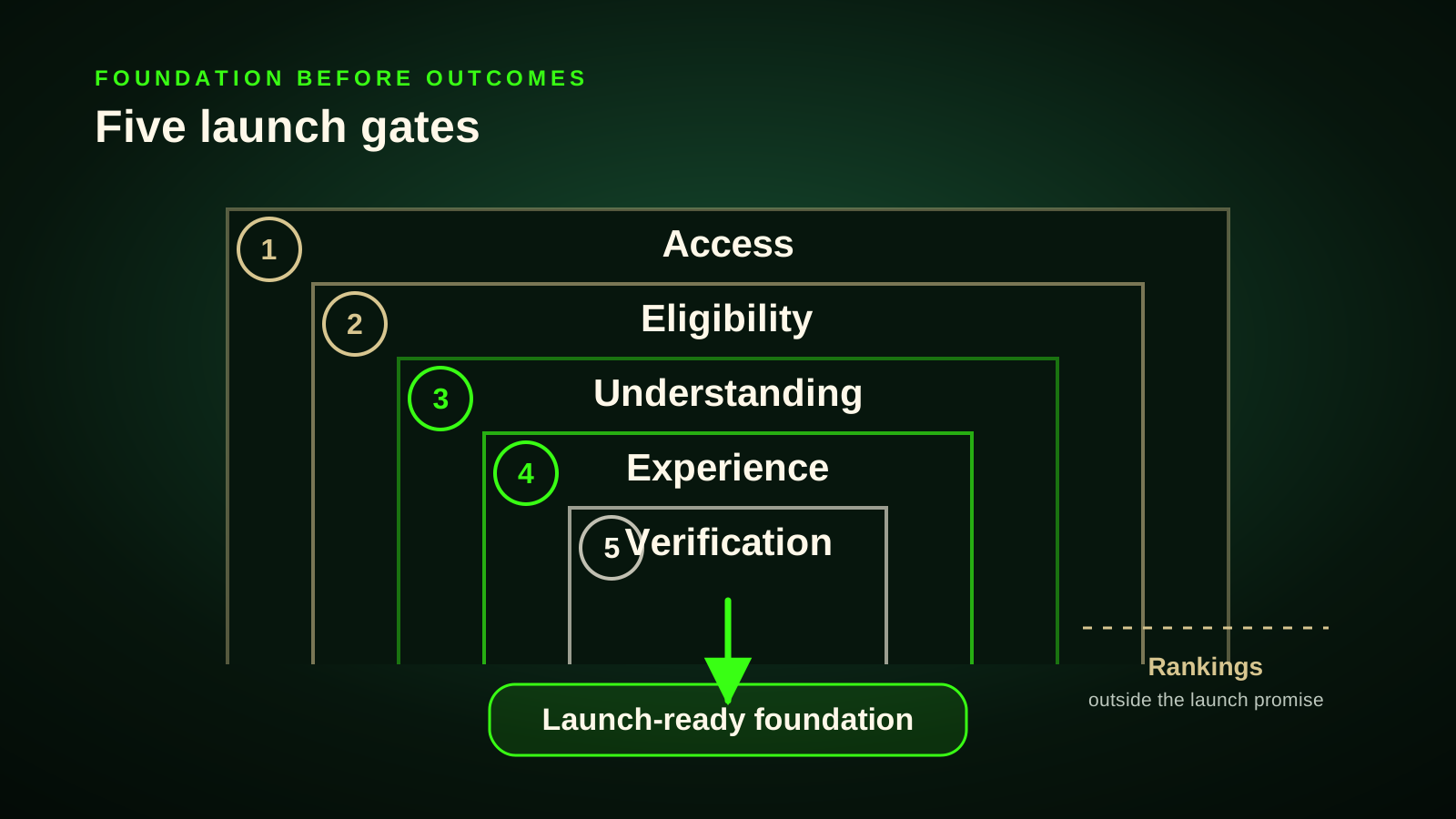
A website can look finished in the browser while shipping with a sitewide noindex, blocked JavaScript, broken redirects, inaccessible mobile content, orphan service pages, misleading status codes, or a sitemap full of the wrong URLs.
That is the useful meaning of SEO-ready: not “guaranteed to rank,” but ready to be discovered, rendered, interpreted, and checked without preventable launch defects getting in the way.
Quick answer Run five gates in order: Access → Eligibility → Understanding → Experience → Verification. Earlier gates have the largest blast radius. A perfect meta description cannot rescue a page that Google cannot access, and schema cannot rescue a URL excluded by noindex.Current as of: Google Search, structured-data, local-business, and generative-search guidance was checked August 27, 2026. Search systems and supported features change. Recheck official documentation before a major migration or a future material update.
“SEO-ready” means eligible—not ranked
“SEO-ready” is not an official Google certification, score, badge, or status. It is a practical launch standard.
A defensible definition is:
An SEO-ready website is one where the pages intended for public discovery are accessible to crawlers, technically eligible for indexing, organized around real user needs, meaningfully linked, usable on mobile devices, truthfully described, and verified on the production website after deployment.
That definition stops before rankings for a reason.
Google Search broadly involves crawling, indexing, and serving results. Passing the launch gates does not guarantee that every page will be crawled, indexed, shown for a query, placed in the local pack, selected for a rich result, or surfaced in a generative answer.
The launch job is to remove avoidable barriers and make the intended meaning clear. The ongoing SEO job is larger: relevance, competition, useful content, reputation, links and mentions, local prominence, freshness, and the quality of the business itself.
| Launch readiness can establish | Launch readiness cannot promise |
|---|---|
| Public pages can be requested and rendered | Google will index every page |
| Indexing directives are intentional | A particular ranking position |
| Important pages are logically linked | Local-pack placement |
| Titles, headings, content, and URLs describe real topics | Rich-result appearance |
| Mobile content and actions work | AI citation or recommendation |
| Search Console can inspect production behaviour | Leads, revenue, or ROI |
The right promise is “launch without self-inflicted search handicaps.” Anything stronger needs evidence the checklist itself cannot provide.
Gate 1: Can crawlers reach the intended public pages?
Access comes first because everything after it depends on the page being reachable.
Public routes must behave like public routes
Before launch, confirm that the production versions of important pages:
- do not require login or an accidental staging password;
- return the expected page rather than an error, blank shell, or redirect loop;
- allow Googlebot to request the HTML and resources needed to understand the page;
- render the primary text, headings, links, images, and structured data;
- expose important links as normal crawlable links rather than click-only JavaScript controls;
- do not require a visitor to click, swipe, expand, or submit something before the primary content exists.
Google can render JavaScript, but that does not make rendering failures harmless. The crawler still has to fetch the page and required resources, execute the application successfully, and receive meaningful rendered HTML.
A React, Vue, Next.js, or other JavaScript-powered site is not automatically bad for Search. A page whose content never renders for the crawler is bad for Search.
HTTP responses should tell the truth
A normal public content page should return a successful response. A removed page should not pretend to be successful while displaying “not found.” A permanent URL move should return a permanent redirect to the most relevant replacement.
| Production behaviour | What it means | Launch decision |
|---|---|---|
200 with the intended content | Normal public page response | Continue to eligibility checks |
301 or 308 to a relevant final URL | Permanent move | Verify direct destination and avoid chains |
302 or 307 used for a permanent move | Temporary signal for permanent work | Review intent and implementation |
404 or 410 for genuinely removed content | Truthful missing-content response | Accept when no relevant replacement exists |
200 displaying “not found” or an empty shell | Soft-error risk | Fix before launch |
5xx, timeout, or blocked request | Server/access failure | Launch blocker |
| Login wall on a page meant for public Search | Inaccessible public content | Launch blocker |
The exact handling of a URL depends on the situation. The rule is simpler: the response, page content, redirect, and intended Search state should agree with each other.
Check robots.txt without treating it as an indexing switch
robots.txt mainly controls crawler access. It is not a reliable instruction to remove a page from Search.
A blocked URL can still be known through links and may appear without normal page-derived information. Blocking CSS or JavaScript can also prevent Google from understanding the rendered page correctly.
Before launch:
- open the production
robots.txtdirectly; - confirm important routes and resources are not blocked accidentally;
- confirm staging-only rules did not leak into production;
- confirm the sitemap reference points to the production sitemap;
- confirm private or irrelevant crawler rules are deliberate rather than copied boilerplate.
Do not celebrate a “clean robots file” while ignoring what the production server actually returns.
Gate 2: Are the intended pages eligible for indexing?
A crawler can access a URL while the page still tells Google not to index it, points at another canonical, resolves through a bad redirect, or presents error-like content.
Understand the difference between robots.txt and noindex
This interaction causes an absurd amount of launch damage.
| Mechanism | What it controls | Common mistake | Correct use |
|---|---|---|---|
robots.txt | Crawler access | Blocking a page and assuming that guarantees removal from Search | Manage crawling when access itself should be limited |
noindex meta tag | Index eligibility after Google crawls the page | Blocking the page in robots.txt, preventing Google from seeing noindex | Exclude a crawlable public URL from indexing |
X-Robots-Tag: noindex | Index eligibility through the HTTP header | Forgetting a CDN/server header still applies after templates are fixed | Exclude non-HTML or server-controlled responses where appropriate |
| Canonical | Preferred version among duplicate or near-duplicate URLs | Pointing every page at the homepage or another unrelated route | Consolidate genuinely equivalent URL variants |
| Redirect | Moves users and crawlers to another URL | Redirecting every removed page to the homepage | Send each valuable old URL to the closest relevant replacement |
Google has to crawl a URL to process noindex. Putting noindex inside robots.txt is not supported by Google.
Fail-closed blockers to inspect
For every indexable page type, verify there is no:
- accidental
noindexin HTML; - accidental
X-Robots-Tag: noindexfrom the server or CDN; - canonical pointing to staging, another domain, the homepage, or a different article/service;
- redirect loop or long redirect chain;
- conflicting canonical, sitemap, and internal-link signals;
- authentication or WAF rule that blocks ordinary crawler access;
- page returning an error-like experience with a successful status;
- duplicate route created by trailing slash, parameters, casing, protocol, or hostname without a deliberate preferred version.
The important word is deliberate. Not every page needs an elaborate canonical strategy, but duplicates and preferred versions should not be left to random framework defaults.
Redesigns need a URL preservation plan
When an existing website changes URLs, SEO readiness includes migration work.
Create an old-to-new map before launch. For each useful old URL, decide whether to:
- preserve it unchanged;
- redirect it to a directly corresponding replacement;
- merge it into a stronger relevant page;
- remove it and return a truthful missing response because no replacement exists.
Do not send unrelated removed pages to the homepage. That creates a poor user destination and weakens the meaning of the redirect.
The website redesign versus new website diagnostic separates intervention depth from migration exposure. Use the pre-rebuild website checklist once larger work is actually justified.
An XML sitemap is a map, not an indexing order
A sitemap is useful because it lists the preferred public URLs and helps Search systems discover or revisit them. It does not force Google to crawl or index anything.
Before launch, the sitemap should:
- use the production hostname;
- contain canonical, public, index-eligible URLs;
- exclude redirects, errors, staging routes, private pages, and accidental duplicates;
- update when the route inventory changes;
- be reachable without authentication;
- be referenced consistently where the site architecture expects it.
After launch, submit or confirm it in Search Console and inspect processing errors. “Sitemap submitted” is not the same as “pages indexed.”
Gate 3: Can users and search systems understand the site?
Eligibility gives a page a chance to be considered. It does not explain what the business does, which service a page represents, or how pages relate to each other.
Build pages around real user needs—not keyword variants
A useful page earns its route because it answers a distinct need.
A roofing business may reasonably separate:
- roof repair;
- roof replacement;
- emergency leak repair;
- metal roofing;
- commercial roofing.
Those pages can have different buyers, proof, processes, FAQs, timelines, and actions.
The bad pattern is creating:
- roof repair;
- roofing repair;
- roof repair company;
- best roof repair service;
- roof repair near me;
- affordable roof repair;
and publishing essentially the same page six times.
| Separate the page when… | Consolidate the page when… |
|---|---|
| The customer problem or decision is materially different | Only the keyword phrasing changes |
| The service scope, proof, process, or eligibility differs | The same service and CTA are being repeated |
| The location has genuine unique business information | The city name is the only meaningful difference |
| The page can stand alone as useful content | The page mainly funnels visitors to another identical destination |
Google’s spam policies specifically warn against doorway pages, scaled low-value content, keyword stuffing, and city or region pages that exist mainly to funnel similar searches into the same destination.
A location page should contain genuine local value: a real branch or service relationship, accurate operating information, local proof, projects, team context, travel or availability details, and content that helps the visitor make a location-specific decision.
Twenty city-swapped pages are not a local strategy. They are twenty maintenance liabilities with spam risk.
Use a logical information architecture
A small-business site does not need a huge route map. It needs a comprehensible one.
A basic service architecture might be:
``text Home ├── Services │ ├── Service A │ ├── Service B │ └── Service C ├── Work / Projects ├── About ├── Guides └── Contact ``
Important pages should be reachable through navigation or relevant contextual links. A sitemap should support the architecture, not substitute for it.
Ask:
- Can a new visitor find the right service without decoding internal company language?
- Can a crawler reach every priority page through normal links?
- Do article links lead to useful service, comparison, or diagnostic pages only where context earns them?
- Are there orphan pages that exist only because someone knows the URL?
- Do breadcrumbs or parent routes reflect a real hierarchy?
Descriptive internal links help both humans and Search systems understand the destination. “Compare website audit scopes” is more useful than “click here.”
Titles should identify the page—not satisfy a character-count ritual
Every important page should have a useful, page-specific <title>.
Good title work:
- identifies the actual topic or service;
- distinguishes the page from other routes;
- uses language a buyer can understand;
- includes location only where the location is genuinely relevant;
- avoids boilerplate repetition and keyword stuffing.
Google can generate the displayed title link from multiple page signals and may rewrite a weak, inconsistent, or overly repetitive title.
There is no Google rule that every title must be exactly 50–60 characters. Practical display constraints exist, but they are editorial constraints—not a ranking compliance test.
Meta descriptions are useful summaries, not ranking switches
A page-specific meta description can help Google form a useful result snippet, but Google may use visible page content instead.
Write descriptions that:
- summarize what the page actually provides;
- distinguish one page from another;
- make the decision or answer clear early;
- avoid unsupported claims and awkward keyword repetition.
There is no fixed Google meta-description length limit. Snippets are generated and truncated to fit the presentation.
Use a semantic heading hierarchy without inventing an H1 superstition
A clear heading structure helps readers and assistive technology navigate the page. A single visible page-level H1 is a strong implementation convention for Synapse articles and service pages.
But “exactly one H1 or Google gets confused” is not an accurate Google ranking rule.
The useful standard is:
- one clear page-level promise;
- H2s for major subtopics or decisions;
- H3s for supporting distinctions and steps;
- no heading levels chosen only to make text look bigger;
- no empty headings or repeated keyword-stuffed headings.
Publish enough content to solve the page’s job
There is no universal word-count minimum.
A contact page may need very little copy. A pricing guide or technical diagnostic may need several thousand words. The correct length is the amount required to answer the actual question honestly and usefully.
Content should:
- reflect real services and boundaries;
- answer meaningful buyer questions;
- add original examples, proof, analysis, or decision support;
- identify facts that change over time;
- avoid mass publishing rewritten source summaries;
- avoid promising rankings, outcomes, or qualifications the business cannot prove.
The article should be useful even if the reader never hires the company. That is the standard—not whether an SEO plugin turns green.
Gate 4: Does the experience work for real visitors?
Technical eligibility without usable execution produces a website that can potentially appear in Search and then waste the visit.
Mobile content must be complete, not a thinner afterthought
Google uses the mobile version of page content for indexing and ranking. The layout can change between desktop and mobile, but the important substance should remain available.
Before launch, verify on a narrow phone viewport:
- the same primary service/content information exists;
- navigation opens, closes, and reaches the intended pages;
- call, form, quote, booking, and contact actions work;
- controls are large enough and spaced well enough to use;
- text, tables, code, diagrams, and images do not overflow;
- sticky bars and overlays do not cover the content or controls;
- primary content is not hidden until a user interaction;
- titles, metadata, structured data, and image alternatives are not missing from the mobile output.
“Responsive CSS exists” is not the test. The customer task has to work.
Accessibility is launch quality—not a ranking trick
Accessibility and Search overlap through semantic HTML, meaningful links, image alternatives, headings, readable content, forms, and mobile usability. WCAG conformance should not be sold as a direct Google ranking factor.
Minimum launch checks should include:
- keyboard access and visible focus;
- meaningful button and link names;
- labels connected to form fields;
- recoverable error messages;
- sensible heading order;
- sufficient contrast;
- informative images with useful alternatives;
- decorative images with empty alternatives;
- no essential information communicated only through colour, animation, or an unlabeled visual.
Automated accessibility checks can find useful defects. They cannot establish full conformance by themselves.
Image SEO starts with image usefulness
For meaningful images:
- use an appropriate text alternative that describes the image’s purpose in context;
- provide surrounding copy or captions where the image proves something important;
- use sensible dimensions and delivery sizes;
- reserve layout space to reduce visual shifts;
- avoid shipping a multi-megabyte hero where a properly compressed version would do;
- do not stuff the
altattribute with service and city keywords.
Decorative images should generally use an empty text alternative so assistive technology does not announce meaningless filenames.
Renaming IMG_4027.webp is lower priority than making the image relevant, correctly sized, accessible, stable, and connected to useful page content.
Performance is friction—not an automatic ranking win
The current Core Web Vitals are:
- LCP for loading;
- INP for responsiveness;
- CLS for visual stability.
Google uses Core Web Vitals in its ranking systems, but good scores do not guarantee top rankings. There is no single page-experience switch that turns a weak page into a winner.
Before launch, use lab tools to find deterministic problems such as:
- an oversized hero asset;
- render-blocking resources;
- excessive JavaScript;
- long main-thread work;
- unstable image or ad dimensions;
- slow server response;
- broken font loading;
- third-party scripts delaying interaction.
After launch, use field data when enough real users exist. Lighthouse is a controlled diagnostic. Search Console Core Web Vitals uses real-user field evidence. They answer different questions.
HTTPS is a security baseline, not an SEO hack
The production website should have:
- a valid certificate;
- no mixed-content breakage;
- consistent HTTPS redirects;
- no malware, injected spam, deceptive redirects, or browser warnings;
- secure handling of forms and private information.
HTTPS matters because the public web should be transported securely and modern browser features depend on it. Do not sell it as a secret ranking technique.
Gate 5: Can you prove the production website passed?
A staging screenshot is not proof of what Google or the public receives after DNS, CDN, hosting, routing, headers, redirects, and caching are live.
Verify the built output before deployment
For representative routes, inspect:
- final production bundle or prerendered HTML;
- title, meta description, canonical, H1, and visible body content;
- robots metadata and HTTP headers;
- JSON-LD syntax and visible-content alignment;
- internal links and heading IDs;
- status codes and redirect chains;
- sitemap and
robots.txtroute inventories; - mobile and desktop layout;
- console/network failures;
- form, call, booking, and contact flows;
- structured data without fake or hidden claims.
A client-side route that looks correct after JavaScript runs but serves an empty generic shell in the raw HTML deserves special scrutiny.
Verify the public origin after deployment
After launch:
- open the exact public production URL;
- inspect the final HTTP status and redirects;
- inspect raw/public HTML where relevant;
- confirm no production
noindex, auth wall, or staging canonical exists; - verify sitemap and
robots.txton the public hostname; - test representative old URLs and redirect mappings;
- test calls, forms, bookings, and lead delivery end to end;
- confirm analytics and conversion events in production;
- inspect representative URLs in Search Console;
- monitor indexing reasons, errors, field performance, and traffic changes.
Search Console does not make a page rank. It is the main diagnostic surface for asking whether Google saw, fetched, indexed, or rejected the production page the way you expected.
Use URL Inspection for representative priority pages rather than smashing “request indexing” on every URL and calling that a strategy.
Keep an evidence receipt
For a professional launch, record:
- route tested;
- timestamp;
- status code;
- canonical;
- index directive;
- redirect source and destination;
- sitemap presence;
- structured-data result;
- mobile/desktop result;
- form/call/booking result;
- Search Console inspection status when available;
- unresolved caveat and owner.
This turns “SEO was included” into a verifiable launch surface rather than a vague line in a quote.
Structured data: describe the page without promising magic
Structured data can help Google understand page entities and make eligible pages available for supported Search features. It does not guarantee a rich result or a ranking improvement.
The critical distinction is:
Valid schema.org vocabulary ≠ Google-supported rich-result type ≠ guaranteed rich result ≠ ranking boost.
As of August 27, 2026:
| Markup | Practical small-business use | Boundary |
|---|---|---|
Organization | Describe the real business identity | Use truthful properties; no visibility guarantee |
LocalBusiness | Describe a genuine local business or customer-facing location | Must match the real business and visible information |
BreadcrumbList | Express a meaningful route hierarchy | Use only where the hierarchy exists visibly |
Article / BlogPosting | Describe genuine editorial content | Dates, author, image, publisher, and headline must be accurate |
FAQPage | Visible FAQ semantics where context justifies it | Do not sell it as an ordinary SMB rich-result tactic |
Service | Valid schema.org vocabulary for semantic description | No dedicated current Google Service rich result should be promised |
Schema should never describe awards, ratings, locations, prices, authors, FAQs, or services that are not actually present and supportable on the visible page.
Local-business SEO needs truthful business identity
Website readiness is one input into local visibility. Google describes local results mainly through relevance, distance, and prominence/popularity. A website cannot eliminate the searcher’s physical distance or buy a better local ranking.
The site should nevertheless make the business unambiguous:
- real business name;
- correct contact paths;
- truthful address where customers are actually served;
- accurate service-area language for service-area businesses;
- maintained Google Business Profile link and website destination;
- real services, hours, categories, proof, photos, and business facts;
- location pages only where they provide real local value.
A service-area business should not publish a fake storefront because an SEO checklist demands an address and embedded map.
An embedded map is useful when it helps a visitor reach a genuine customer-facing location. It is not mandatory SEO plumbing.
Tiny formatting differences such as “Street” versus “St.” are not a useful explanation for every local-ranking problem. Accurate identity and relevance matter more than punctuation fetishism.
Search Console measures discovery; GA4 measures behaviour
These tools belong in different categories.
Search Console
Use Search Console to:
- verify ownership;
- submit and inspect sitemaps;
- inspect individual URLs;
- review indexing reasons;
- see search queries, pages, countries, and devices;
- monitor crawl, security, HTTPS, and Search performance issues where available.
It is not a ranking button.
GA4 or another analytics system
Use analytics to understand:
- traffic sources;
- landing pages;
- user behaviour;
- forms, calls, bookings, purchases, and other events;
- conversion paths and business outcomes.
Installing GA4 does not make a page crawlable, indexable, or rankable. It lets the business measure what happened after the visit.
A website can be technically SEO-eligible without GA4. A professional launch should still implement measurement where the business needs it and can handle privacy and consent correctly.
AI-search readiness inherits the same foundation
Google’s current 2026 guidance says its generative Search experiences use the normal Search index, ranking, and quality systems. Pages still need ordinary Search eligibility and useful content.
Google also explicitly says it does not use llms.txt, special AI text files, special markup, or Markdown copies to improve Google Search or generative-Search visibility. There is no special generative-AI schema requirement.
That means these do not belong in the baseline SEO-ready gate:
llms.txtas a Google ranking tactic;- Markdown mirrors for “Google AI SEO”;
- a special AI schema package;
- mass-produced answer pages;
- guaranteed AI citation claims.
Other vendors have their own crawlers and policies. Those can be reviewed when the channel matters, but they are vendor-specific engineering decisions—not universal Google SEO requirements.
Once the baseline gates are sound, read AI Search Readiness for Small Business Websites for the broader identity, proof, action, and cross-platform layer.
The full launch lifecycle checklist
Must pass before launch
- intended public routes work without authentication;
- important pages return truthful status codes;
robots.txtdoes not block priority pages or required resources;- no accidental HTML or header-level
noindexexists; - important content renders without requiring user interaction;
- canonical and duplicate URL handling is deliberate;
- redirect maps exist for changed valuable URLs;
- page architecture reflects real services and user needs;
- no keyword-variant or city-swapped doorway set is being launched;
- titles and visible headings identify each page;
- priority pages have crawlable internal links;
- mobile contains the primary content and usable actions;
- HTTPS and production certificates work;
- forms, calls, bookings, and lead delivery function;
- informative images have meaningful alternatives;
- major accessibility blockers are corrected.
Should complete before launch
- page-specific meta descriptions;
- descriptive and maintainable URLs;
- sitemap containing canonical public routes;
- Search Console ownership prepared;
- Organization/LocalBusiness/Breadcrumb/Article markup where truthful and relevant;
- lab performance and accessibility smoke checks;
- social metadata and share images;
- analytics and conversion tracking where the business needs measurement;
- production route and metadata inventory;
- rollback and post-launch monitoring plan.
Verify immediately after deployment
- public status codes and redirect destinations;
- public
robots.txt, sitemap, canonical, and index directives; - raw or rendered production content;
- sitemap processing in Search Console;
- live URL Inspection for representative routes;
- old-to-new URL mappings;
- broken navigation/internal links;
- forms, calls, bookings, and notification delivery;
- analytics and conversion events;
- structured data on the public origin;
- mobile layout, console errors, and horizontal overflow.
Ongoing SEO and website work
- monitor indexing and Search performance;
- expand or improve content around genuine customer needs;
- maintain accurate business and profile information;
- update stale services, prices, hours, proof, and policies;
- repair broken links, forms, integrations, and redirects;
- monitor real-user Core Web Vitals;
- earn reputation, mentions, reviews, and links through real business activity;
- review changing Google feature and structured-data guidance;
- measure qualified leads and revenue rather than traffic alone.
Optional or context-dependent
- embedded map for a real customer-facing location;
Serviceschema as semantic vocabulary;- FAQ content for genuine remaining reader questions;
- vendor-specific crawler controls;
- experimental
llms.txtor Markdown surfaces for systems that actually consume them; - advanced AI-discovery measurement;
- specialized local, ecommerce, news, product, or international SEO requirements.
SEO checklist advice to reject
| Advice | Why it fails |
|---|---|
| “Use 1–2% keyword density.” | Google provides no target density; unnatural repetition becomes keyword stuffing. |
| “Add meta keywords.” | Google does not use the meta keywords tag for Search. |
| “Every page needs 1,500 words.” | There is no universal word-count requirement. |
| “Every title must be 50–60 characters.” | Useful editorial range, not a Google rule. |
| “Every meta description must be 150–160 characters.” | Google sets no fixed limit and may generate another snippet. |
| “Exactly one H1 is a ranking requirement.” | Clear hierarchy is good; magical heading-count claims are overstated. |
| “Create a page for every keyword version.” | Produces duplication and doorway/scaled-content risk. |
| “Create a page for every town by swapping the city name.” | Thin city-funnel pages can violate doorway/scaled-content policies. |
| “Schema makes the page rank.” | Structured data supports understanding and feature eligibility, not a general ranking boost. |
| “FAQ schema gets normal businesses FAQ rich results.” | Current eligibility is heavily restricted and should not be promised. |
| “Service schema creates a Google Service rich result.” | Valid vocabulary is not the same as a supported Google feature. |
| “Submitting a sitemap gets pages indexed.” | Submission is a hint, not an order. |
| “Block the page in robots.txt to remove it from Search.” | Wrong tool; a blocked URL can still be known or shown. |
“Put noindex in robots.txt.” | Google does not support it. |
| “Install GA4 to make the site SEO-ready.” | Analytics measures behaviour; it does not create Search eligibility. |
| “Green Core Web Vitals guarantee rankings.” | They are ranking-system inputs and user signals, not a guarantee. |
| “HTTPS is an SEO trick.” | It is a baseline security requirement. |
| “Tiny NAP punctuation differences destroy local rankings.” | Accurate identity matters; punctuation folklore is overstated. |
| “Buy an old domain for instant authority.” | Domain age is not a baseline readiness requirement. |
| “Submit the site to hundreds of search engines.” | Search engines normally discover pages through crawling; sitemap submission is enough for the relevant platforms. |
“Add llms.txt so Google AI cites you.” | Google currently says it does not use the file for Search visibility. |
| “Create special Markdown pages for Google AI.” | Google currently says no special Markdown representation is required. |
What a professional SEO-ready handoff should contain
A useful launch handoff is not a screenshot of an SEO plugin score.
It should include:
- approved public route inventory;
- title, description, H1, canonical, and robots status by route;
- redirect map where applicable;
- sitemap and
robots.txtlocations; - structured-data types and validation notes;
- Search Console ownership and sitemap state;
- production verification receipts;
- unresolved risks and who owns them;
- post-launch monitoring plan;
- explicit statement that indexing and rankings are not guaranteed.
That is what turns “SEO included” into work the business can inspect.
Useful next step
Run the gates from left to right and stop at the first failure:
Access → Eligibility → Understanding → Experience → Verification
Treat access and indexability defects as launch blockers. Treat schema, AI files, and tool scores as lower-priority enhancements or experiments. Then keep the ongoing work—content, reputation, local prominence, proof, and qualified-lead measurement—outside the launch checklist where it belongs.
Source notes
This article was rebuilt from the approved Synapse source pass checked August 27, 2026. It reorganizes the research into a launch-gate sequence rather than reproducing the source report.
- Google Search technical requirements and How Search Works — access, successful responses, crawling, indexing, and non-guarantee boundaries.
- Google SEO Starter Guide and creating helpful, reliable, people-first content — architecture, internal links, useful content, and anti-cargo-cult guidance.
- Google robots.txt guidance, `noindex` guidance, and robots meta documentation — crawl versus index-control boundaries.
- Google canonical guidance, sitemap guidance, and site-move guidance — duplicate handling, discovery hints, redirects, and migration preservation.
- Google title-link guidance, snippet guidance, crawlable-link guidance, and URL structure guidance — page understanding and result presentation.
- Google mobile-first guidance, Core Web Vitals, and page experience — mobile content, performance, and ranking non-guarantees.
- Google structured-data policies and Search Gallery — visible-content accuracy, supported features, and rich-result non-guarantees.
- Google Business Profile local ranking guidance and service-area business guidance — relevance, distance, prominence, and truthful location/service-area information.
- Google Search Console URL Inspection, Page Indexing, and sitemap reporting — production verification and ongoing diagnosis.
- W3C WCAG 2.2 and WAI images tutorial — accessibility and image-alternative boundaries.
- Google’s generative-AI optimization guide — current Google position that foundational SEO still applies and no special
llms.txt, Markdown, or AI schema is required for Google Search visibility.
Platform and Search-feature details are current as of August 27, 2026 and should be rechecked during material updates.